Summarize this article with AI
Run one domain through two SEO tools. You'll walk away with three different stories. Semrush hands you an Authority Score. Moz hands you a Domain Authority that doesn't line up. Search Console then reports traffic neither tool saw coming. Most Semrush vs Moz comparisons line up feature badges and crown a winner. But that's not the question in front of you.
Across six categories, you'll see numbers from both: domain strength, search volume, keyword difficulty, backlinks, traffic, spam signals. Separate crawlers. Separate keyword databases. A different click-through model under each one. The scores look alike. So the labels match. The meanings don't. Even the vendors' own help pages disagree on how big their indexes are.
Here's where this Semrush vs Moz guide lands: how each number gets built, and why the two drift apart. Before trusting either tool on a competitor, you'll want to check its numbers against the clicks and impressions already sitting in your Google Search Console. The next few sections walk through that. By the end? A calibration check you can rerun, a price table dated to this month, and a short list of third-party claims the vendor pages no longer back up. Time to dig in.
Semrush vs Moz: the quick answer
Six overlapping categories, scored by both tools. Those numbers rarely agree. Every score is a model trained on the vendor's own index, keyword database and refresh clock. When the two scores split, that's the models disagreeing, not a verdict on your pages. Your own pages? Google Search Console is the reference.
| Metric | Semrush | Moz | Why they differ | Use it for |
|---|---|---|---|---|
| Domain strength | Authority Score, 100-point scale, links plus an organic-traffic estimate plus spam checks, refreshed every two weeks | Domain Authority 1 to 100, link-based ML, moves when Moz finds new links | Different inputs and link indexes | Comparing domains inside one tool |
| Search volume | Single monthly number, 12-month average | Single number or a range in US, CA, AU and UK, 12-month average | Different data partners, rounding and country sets | Sizing demand, not forecasting clicks |
| Keyword difficulty | 0 to 100, from referring domains and Authority Score of the top pages | 1 to 100, from top-10 Page Authority | Built on each tool's own index | Ranking a keyword list inside one tool |
| Backlinks | 43 trillion links, Semrush stats page (as of Oct 24, 2026) | 45.5 trillion links, Moz Link Explorer page (Oct 2026) | Crawl choices and retention rules | Trends over time in one tool |
| Traffic | Domain and page traffic modeled from positions, volume and CTR | No domain-level estimate; estimated clicks per keyword | Moz doesn't model it | Rough competitor sizing after you calibrate it |
| Spam signals | Toxicity Score per backlink, 0 to 100, rolled up per profile | Spam Score per site, a percentage from 1% to 100% | They answer different questions | Triage, not an automatic disavow |
Short verdict. Semrush wins when competitor traffic and keyword-gap work drive your week. Long-tail coverage runs deeper. Daily rank tracking too. And every extra toolkit sits behind the same login. Moz Pro is the one to reach for when clients already know link metrics and Domain Authority, when entry prices and seat costs sting, and when weekly rank checks cover it. Prices and limits are in the verdict section below.
Trust note. Every definition, scale, index size and price in this article comes from Semrush's and Moz's own pages, read in October 2026. Nothing claims a hands-on head-to-head run. SEO Heatmap is our product, and it doesn't produce any of these metrics: it visualizes your own Google Search Console clicks in a page-by-month heatmap, free for one property.
Why Semrush and Moz never show the same number
Both tools live in their own walled garden. Behind each are its own crawler and link index, a data partner feeding the keyword database, and a click-through model turning positions into traffic estimates. Every piece refreshes on a separate clock. From far away, the two 100-point scales look the same. Get closer and they measure different things.
That shapes what "reliable" even means here. A single tool keeps its method steady, so trends and relative rankings within it tend to be solid. Jump between tools and the only honest comparison is the definitions and dates each vendor publishes. Authority Score isn't a Google metric. Domain Authority isn't either, and both vendors come out and say so on their own pages.
Your pages? Only Search Console reports your real clicks and impressions. Problem is, it says nothing about anyone else's pages. That's the hole each tool plugs with a model of its own. In a Semrush vs Moz decision, point either tool at competitor-sized questions. Then let your Search Console data decide how much faith either model has earned.
Even the vendors' own pages disagree on their size
Index and database sizes drift between a vendor's product page, help center and marketing pages. Date every figure you quote.
| Figure | Vendor's own page (date) | Other numbers you'll see |
|---|---|---|
| Semrush keyword database | 29.2 billion (stats page, as of Oct 24, 2026); 28.8 billion (knowledge base, 2026); 26.7 billion (Semrush's vs page, data as of May 2025) | 25 billion, 27.9 billion, 28.9 billion on third-party articles |
| Moz keyword database | 1.25 billion suggestions (Keyword Explorer page) | Same figure elsewhere |
| Semrush backlinks | 43 trillion links and 390 million referring domains (stats, Oct 24, 2026); the same page counts 808 million domain profiles | One competitor article wrote "43 million," a typo worth flagging |
| Moz backlinks | 45.5 trillion links on Link Explorer, Domain Analysis and API pages; Moz's own menus say "over 44 trillion" and "over 40 trillion" | 45.8 trillion and about 41 trillion in two third-party articles |
Two things stand out. On the vendors' own current pages, Moz's link index is slightly larger and Semrush's keyword database is about 23 times larger. On its own blog in October 2026, Semrush even concedes that Moz's published backlink index is the bigger one.
Dull but worth doing: whenever you quote an index size, note the page you got it from and the date you read it. Undated index figures floating around online can be years stale.
Authority Score vs Domain Authority
Authority Score and Domain Authority answer the same question, "how strong is this domain," with different ingredients. Neither is a Google ranking factor. Each is a model trained on its own data.
Authority Score from Semrush uses a 100-point scale.1 The knowledge base calls it 1 to 100; the blog says 0 to 100. Three signal groups go into it. Link Power counts dofollow referring domains and their own authority. Organic Traffic estimates how much search traffic the site should pull in given its keyword positions and the click potential at those positions.
Natural Profile deducts for six spam patterns: no rankings in Google's top 100, more than 90% dofollow referring domains, links out of line with organic traffic, too many referring domains on the same IP address, too many on the same IP network, and another domain with an identical backlink profile.1 Semrush rebuilt the formula in January 2023, and the score refreshes every two weeks for every domain in the index. Semrush is upfront about this: it's a tool for comparing domains, not a grade of good or bad on some absolute scale.
Moz's Domain Authority? Also 1 to 100, logarithmic. Climbing from 20 to 30 is far easier than from 70 to 80. A machine-learning model produces the score, trained mostly on backlink data from the Link Explorer index. Dozens of inputs go in. The heaviest are linking root domains and how strong those domains are themselves. Page Authority does the same math per URL.
Both scores move only when Moz finds new links or updates the model, and both are relative to Moz's index: when big sites gain links, smaller sites' scores can slide down even without losing any links. There's also Brand Authority, a separate 1-to-100 non-linear score Moz builds from branded-search demand across the US, UK, CA and AU data.
So why does one site get two scores? Different link indexes, for one. Authority Score bakes in a traffic estimate and spam deductions on top of links. Domain Authority sticks to links. And they refresh on separate clocks. There's no conversion. Keep each score inside the tool that made it. Don't drop them into the same column of the same table.
Correlation studies read small. Onely's 2022 study, 10 domains and 2,000 keywords, pegged the average correlation between Domain Authority and ranking at 0.16. Authority Score wasn't in that study. Treat these numbers as context. They're not proof of anything. Both tools are already telling you their scores are not Google.
Search volume: two 12-month averages from different data
Both tools show search volume as a 12-month average of monthly queries. That guarantees a mismatch with Search Console in any single month. What Search Console reports is actual impressions for that month, not a yearly average. Seasonal keywords run above or below the average by design.
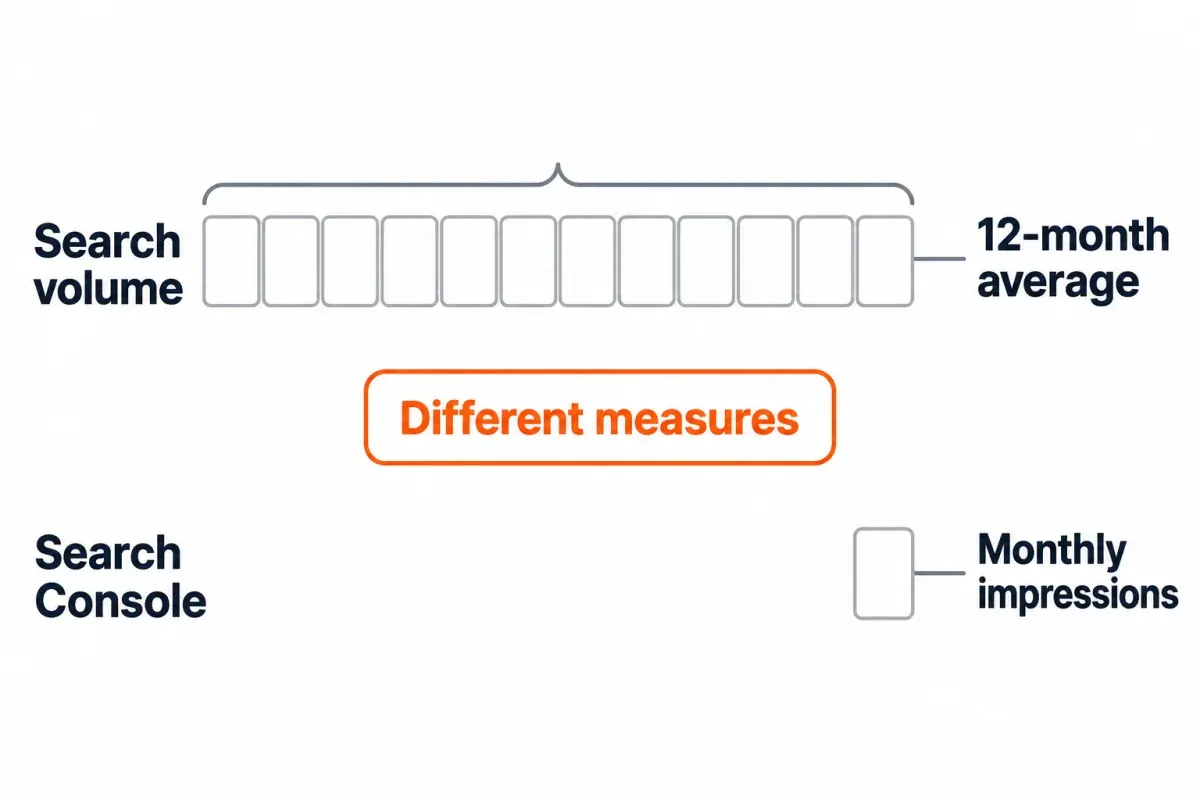
Semrush builds its volume from third-party data overlaid with historical clickstream data, trained into a model and applied to billions of keywords.2 There are 142 country databases, mobile and desktop are combined into one number, and the database refreshes monthly with history back to January 2012. On-demand refreshes use a per-plan budget (Semrush calls these "keyword metric updates"). The stats page lists 29.2 billion keywords as of October 24, 2026.
Moz shows a single number or a range for Google US, CA, AU and UK, with "Data not available" when it has none. Moz doesn't publish its current method in its help docs: the 2016 Keyword Explorer launch described volume buckets plus about one million US clickstream searchers, and that's the newest write-up you'll find on Moz's site. On the Keyword Explorer page, Moz lists 1.25 billion keyword suggestions. For long-tail queries, Semrush will often have a number and Moz will not.
Semrush's own 2022 study is the most-cited volume comparison. Semrush took 10,000 US keywords, used Search Console impressions of top-3 URLs as a stand-in for truth, and compared seven tools, including Moz, Ahrefs, Serpstat, Sistrix and Google Keyword Planner. Semrush came out closest to the Search Console figure in every head-to-head.
It's a vendor-run study, now four years old, and impressions are a proxy for volume, not volume itself. Call it directional and move on.
Use either tool to size demand and to rank a keyword list within one database. Don't try to forecast clicks straight from a volume number. You still need a guess at position and a CTR assumption, and both shift with the SERP layout.
Keyword difficulty: a 30 in Semrush isn't a 30 in Moz
Both difficulty scores run 0 to 100, which is why they get compared head-to-head. The inputs don't line up at all.
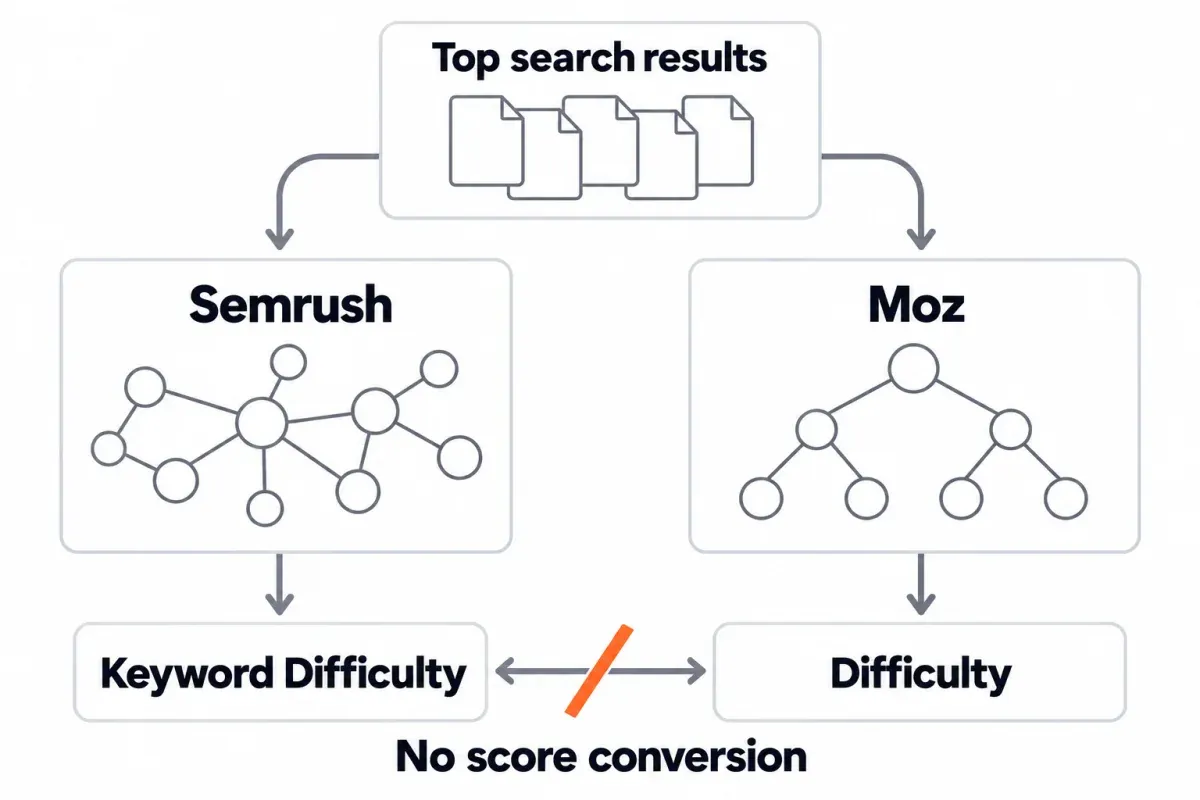
Semrush's KD% looks at the pages ranking in the top 10 and takes the median referring domains, the median ratio of dofollow to nofollow links, the median Authority Score of the ranking domains, and what Semrush calls the SERP-related qualities of the keyword.3 Scores land in six bands. Easiest covers 0 to 14. Possible is 30 to 49. Then difficult at 50 to 69, up to the hardest at 85 to 100. Think of it as how much work it'll take to reach the top 10. Personal Keyword Difficulty adjusts the score to your own domain.
Moz's Difficulty is a weighted average of the Page Authority of the top 10 blue links, with the higher, more visible results weighted up by projected CTR, then adjusted for Domain Authority, homepages and how the ranking pages use the query terms. Moz says keywords get much harder to rank for around 40. Moz also publishes a separate Priority score (volume, Difficulty, Organic CTR and your own importance score). Priority is not Moz's name for difficulty, which is a common mix-up in third-party guides.
Each score lives in its own index. Semrush grades those ranking pages by referring domains and Authority Score, which is Semrush's own metric. Moz grades them by Page Authority, which is Moz's own metric. So a 30 in Semrush and a 30 in Moz are two different statements about the same page.
The useful play: rank your keyword list inside one tool, then see which difficulty scores you've actually ranked for by lining the tool's top candidates up against your Search Console queries. That's your personal threshold, and it beats either tool's generic bands.
Backlink counts: why one site can show 3.7k or 611k referring domains
The clearest published example of two tools disagreeing on the same site is Style Factory's ten-site table (in its comparison updated September 2026). It ran Amazon, a handful of ecommerce platforms and several website builders through both tools and reported 3.7k referring domains for Jimdo in Moz against 611k in Semrush, 49k for Squarespace in Moz against 407k in Semrush, and 5.6 million for Amazon in Moz against 4.5 million in Semrush.
Semrush found more on six sites, Moz on four. The article called it "pretty close." The 160-times gap on Jimdo says otherwise.
Two documented choices explain much of what you see, and a third is a likely suspect.
First, what each crawler decides to visit. Moz runs Dotbot with a machine-learning model trained to pick pages like those appearing in Google's search results, and re-crawls high-quality pages at least every 90 days. Semrush says it crawls about 10 billion URLs a day with its own crawler. Those are different libraries by design.
Second, how long a link stays in the index. Moz keeps a link until its crawler can't find it, then marks it "Lost"; it doesn't expire links by age. Semrush's own 2021 study said it drops links not seen in six months, and found Moz still counting links from pages Semrush saw as dead. That's a vendor-run claim, and Majestic's reply the same month warned against vendor-led index size comparisons.
Third, and this one is an inference, not a documented rule: the biggest gaps in that table are on website builders (Jimdo, Squarespace, Wix), whose users' sites often link back to the platform. Whether a tool crawls those user sites, and whether it counts each one as its own referring domain, could move a count by orders of magnitude. Neither vendor's help pages walk through that case.
Vendor-published index sizes don't help with any single site. On its stats page from October 24, 2026, Semrush publishes 43 trillion backlinks and 390 million referring domains. Across Link Explorer and Domain Analysis, Moz publishes 45.5 trillion links, 8.7 trillion URLs and one billion domains. Those are index-wide headline figures. They tell you nothing about which site either crawler sees best.
The rule? Small and strict. Compare link counts within one tool over time, or across competitors in that same tool. Don't ever subtract one tool's referring-domain count from the other's and call the difference a win or a loss.
Traffic estimates: Semrush models them, Moz mostly doesn't
Two different traffic numbers come out of Semrush, and they look alike. In Domain Analytics (Domain Overview, Organic Research, Top Pages), every tracked position gets multiplied by volume and an average CTR, and the total shows up as organic traffic. Semrush's own knowledge base describes these numbers as how much traffic a site "COULD get" from its positions, and tells users to measure their own site's traffic in Google Analytics instead.
The Traffic & Market Toolkit is a different product, built on a clickstream panel of over 200 million anonymized internet users across more than 190 countries, and it covers all traffic channels. Semrush says the two numbers will almost always differ. Access to Traffic & Market is bought per user on top of the plan (its knowledge base prices it at $289 per user).
Moz has no domain-level traffic estimate. Domain Analysis shows "Keywords by Estimated Clicks" (volume multiplied by Moz's Organic CTR). A Moz Pro Campaign can show your own Site Traffic, but that comes from a Google Analytics connection you make yourself, not from Moz's crawl. If you've seen why Search Console clicks and Google Analytics sessions don't match, you already know Site Traffic won't line up with Search Console either.
Published studies tell you to treat any model as a wide range. Ahrefs' 2022 traffic accuracy study ran 1,635 sites against Search Console and reported a 68.4% median deviation for Semrush (and a 49.5% deviation for Ahrefs itself).4 It's a competitor-run study, and Moz isn't in it because it doesn't publish a domain traffic figure.
Varn's 2025 look at 32 client sites found Semrush within 10% of Search Console only twice; where it overestimated, it overestimated by 152% on average. Small sample, UK agency, but it's the sort of range to expect.
The practical move is to calibrate on your own site before you quote any tool's traffic figure for a competitor. The next section walks that calibration.
Spam Score vs Toxicity Score: two different questions
On the surface, these two signals look like twins. They don't.
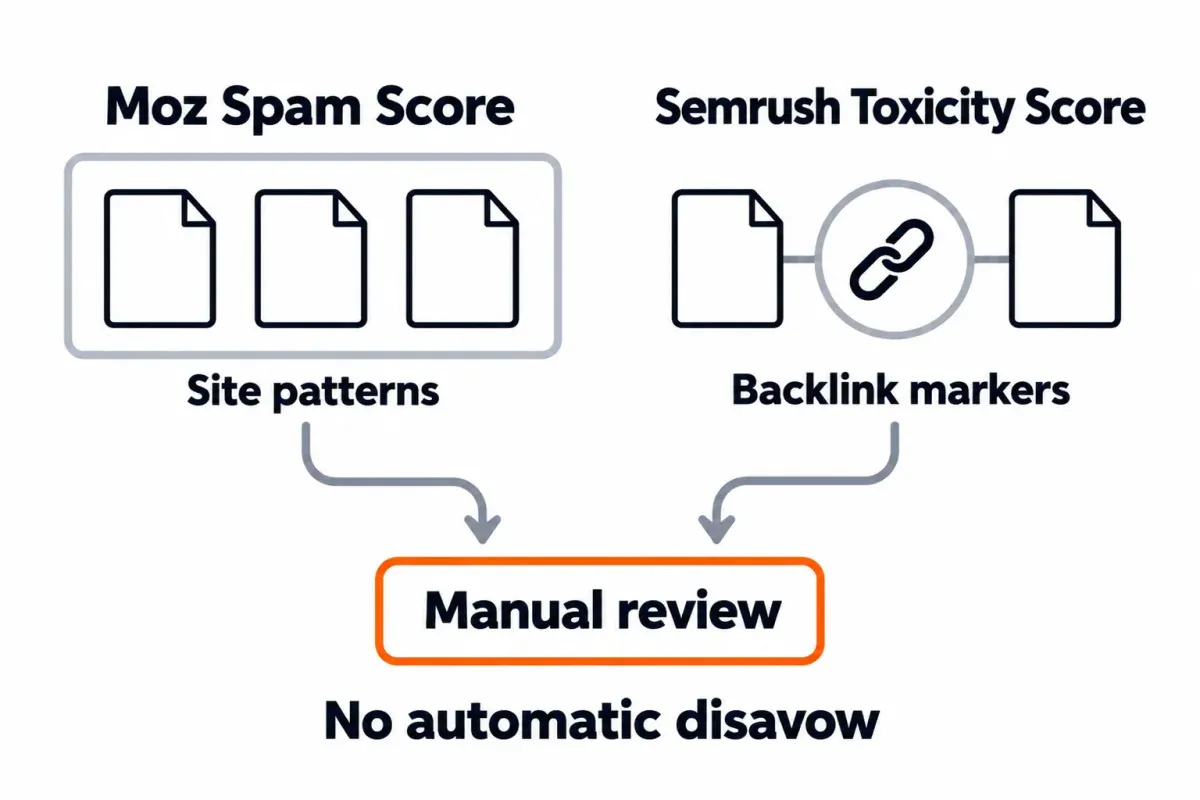
Moz's Spam Score is per site. It's the percentage of sites with similar features that Moz found to be penalized or banned by Google, from a machine-learning model that identified 27 common features among those sites. Moz says the score is correlation, not causation, and a high score doesn't mean a site is actually spammy. You see it on any site in Link Explorer or inside a Campaign, with a breakdown of linking domains by score band.
Semrush's Toxicity Score is per backlink.5 It runs 0 to 100 from 45-plus "toxic markers," including link networks grouped by shared IP, Google Analytics ID, AdSense ID or whois, blog comment and forum spam, de-indexed domains, malicious domains and community disavow signals. Inside a Backlink Audit project, Semrush rolls the per-link scores up into an Overall Toxicity Score of High, Medium or Low depending on the share of toxic links in your profile.
Semrush's blog post from January 2026 and its current knowledge base both describe the feature as live. There's no replacement announced on Semrush's pages. Separately, Authority Score applies its own six spam checks through its Natural Profile group.
Different questions, different answers. A linking site can light up high in one tool and come in low on the other. A domain that resembles sites Google penalized may still be clear of the exact markers Semrush looks for. The reverse can happen too.
Either score is a shortlist. The actual review happens by hand. Semrush is blunt about it: disavow only after a manual action, or when you know there's clear past manipulation. Moz says a higher Spam Score, on its own, isn't a reason to disavow, just a reason to start looking. And Google warns a careless disavow can hurt a site's performance in Search.6 Triage, don't automate.
How to check Semrush or Moz against your Search Console data
Search Console is the only place where you know your site's real clicks and impressions. Which is why it works as the bench to calibrate either tool against. The point isn't to grade Semrush or Moz against a ground truth and name a winner. It's to see how far each tool runs high or low on sites like yours, so you can shade its competitor figures up or down.
Match before you compare. Semrush's databases are per country, so filter Search Console by the same country. Match the month. Match device where the tool separates it.
One wrinkle: Search Console strips out anonymized queries (searches issued by only a few dozen users across two to three months), so query totals come in below page totals. The UI export stops at 1,000 rows. Anything bigger, our bulk Search Console export guide covers.
Then line things up like for like.
| Tool number | Compare with in Search Console | Watch out for |
|---|---|---|
| Page or domain traffic (Semrush Domain Analytics) | Clicks for the same page and month | Semrush models traffic a site "could get"; your real clicks can run well above or below it |
| Estimated clicks per keyword (Moz) | Clicks for that query, same month | Moz's figure is volume times an estimated CTR, and anonymized queries are missing from Search Console's query rows |
| Search volume (either) | Impressions, only for queries where you sit in positions 1 to 3 | Volume is a 12-month average; impressions are monthly actuals |
| Position (either) | Average position for the same query and date | Moz tracks weekly and only to position 20; Semrush tracks daily |
In order.
- Start with 10 to 20 pages whose clicks don't bounce around, and 20 to 30 non-seasonal queries already ranking top 3.
- Over in Search Console's Pages tab, turn the country filter on, then pull clicks for each page for one recent month. Need help spotting steady pages? SEO Heatmap's Pages heatmap lays out each page's clicks month by month over 16 months (all countries combined).
- For the same month, grab Semrush's estimated traffic on those pages, or Moz's estimated clicks on those queries.
- Divide tool by Search Console on each page. Note the median ratio and the spread (min to max).
- Do the volume check on the top-3 queries from step 1, using months after April 27, 2026 (see the anomaly note below).
- When the tool quotes you a figure for a competitor page, divide it by your median ratio to get the midpoint, then by your highest and lowest ratios to get the range.
A worked example with clearly illustrative numbers. Say the tool pegs a page at 1,200 monthly visits. Search Console shows that page actually pulls 800 clicks. That's a 1.5 ratio.
Do that across 15 pages and the ratios can scatter from 0.6 up to 2.4. Tool quotes a competitor page at 3,000? The real number probably sits somewhere between about 1,250 and 5,000, with a midpoint near 2,000. 3,000 isn't the honest answer. It's "a few thousand."
One Search Console gotcha. Google's data anomalies page for Search Console records a logging bug that kept the tool from reporting impressions accurately from May 13, 2025 through April 27, 2026.7 Clicks came through fine. If your window overlaps those dates, lean on clicks and leave impressions, CTR and average position alone.
For volume-against-impressions checks, use months after the fix only. As of October 2026, that's about six clean months, so lean on clicks where you can. If you want a step-by-step walk-through of reading a Search Console change, see our SEO data analysis guide.
Semrush vs Moz Pro: which one fits your work
The Semrush vs Moz choice usually comes down to which workflow matters more and what the seats cost. Prices and limits below are from Semrush's and Moz's own pages in October 2026, with billing basis called out in every cell.
Moz Pro. Starter $49 per month (public limits not shown on the pricing page today). At $99 a month (or $79 billed yearly), you get Standard. That covers one user, three campaigns, 300 weekly tracked keywords, 150 keyword queries a month, 100,000 pages crawled weekly, and 150 AI prompts tracked. Medium runs $179 a month, or $143 on annual billing. Add a second user to Standard, bump campaigns to 10, weekly keywords to 1,500, queries to 5,000, pages to 500,000 a week, and prompts to 300.
Large sits at $299 per month ($239 yearly), stretching the limits to 3 users, 25 campaigns, 3,000 keywords, 15,000 queries, 1.25 million pages and 600 prompts. Extra seats are $49 per month on any plan. The trial is seven days on Medium.
Semrush. Free plan: 10 analytics requests a day, one tracked site, 10 tracked keywords, no card. The SEO plan is about $140 per month ($139 on Semrush's US pricing page, $139.95 in its help docs). Starter runs $199 a month, or $165.17 a month billed yearly. A single seat, bundled SEO and AI Visibility Toolkit, 500 keywords tracked daily, and five projects. Pro+ comes in at $299 a month, $248.17 on annual billing. That lifts you to 15 projects, 1,500 keywords, and larger reports. Advanced is priced on request.
Extra seats are $45 per user on Starter, $80 on Pro+ and $100 on Advanced, plus $99 per user if that seat needs AI Visibility access. The Traffic & Market Toolkit, Local, Content, Social and Advertising toolkits are paid add-ons. Seven-day trial.
Pick Semrush if competitor traffic and keyword-gap work are what fill your week. Need the much bigger keyword database for long-tail work, daily rank tracking that digs deep in the SERP, or a stack of toolkits (traffic, local, content, social, ads) under one login? Semrush again. Site Audit comes bundled in the SEO plan for technical SEO issues. Its SEO Toolkit handles backlink analysis and the Backlink Audit project described above. Paid add-on toolkits reach further: Advertising for PPC, Social for social media management and Content for topic ideas. Semrush's SEO-only plan, at roughly $140, lands between Moz Pro Standard's $99 and Medium's $179.
Moz Pro suits you better when clients already know link metrics and Domain Authority. Or when entry pricing counts for you, or you need more seats than the entry plans give you. Moz bundles two users on Medium and three on Large, and extra seats run $49, against $80 on Semrush Pro+ and $100 on Advanced. It also bundles AI visibility prompts from Standard up (150, 300 and 600 prompts by plan across GPT, Gemini and Google AI Mode). It fits when weekly rankings are enough. Keyword research runs through Keyword Explorer with its Search Intent labels. Link Explorer handles backlink analysis and link-building. Site Crawl flags technical SEO issues on pages you own.
Keyword research and competitor overviews? Either tool fills in for the other. Neither replaces Search Console for your own site. For the deeper, tier-by-tier Moz price breakdown, see our Ahrefs vs Moz article. If you've decided to leave Moz, see our Moz alternatives guide. If you want to try Semrush-adjacent tools for free first, see our free Semrush alternatives roundup.
Claims in other comparisons that are out of date
Third-party comparison articles age fast. Here's what the vendor pages actually said in October 2026, next to claims that still get repeated.
| You may read | Vendor pages say (October 2026) |
|---|---|
| Moz has a 30-day trial | Seven days on Medium, from the checkout page |
| Moz has no search intent feature | Keyword Explorer shows Search Intent |
| Moz's difficulty is its Priority score | Difficulty and Priority are separate metrics |
| Moz has no AI features | AI visibility prompt tracking is included from the Standard plan |
| Semrush plans are Pro, Guru and Business | Current plans are SEO, Starter, Pro+ and Advanced (the legacy SEO Toolkit is still documented separately) |
| Moz top plan includes five users | Three users on Large; extra seats are $49 each |
If a piece tells you Moz has "No AI," or prices Semrush only as Pro, Guru and Business, look at the publish date before trusting anything else in it.
Before you call either tool's numbers wrong
The takeaway from any Semrush vs Moz comparison: both are models trained on their own data. The numbers disagree because the models disagree, not because one is lying. For your own site, see your real clicks first. SEO Heatmap plots the Search Console clicks on every page as a heatmap, by month (16 of them), week, or quarter. Growing and falling filters come built in. The AI insights surface your top gainers and losers, and a Sheets or Excel export gets you past the 1,000-row cap. One property is free. Spot the steady pages, watch each one's monthly trend, and see what they actually earn before you shave down either tool's traffic estimates.
Frequently asked questions
Is Moz reliable?
Yes, in a narrow sense. Within Moz's own index, scores and link counts stay consistent, so any trend or comparison you keep inside Moz holds up. Just don't treat it as a stand-in for Google. Moz's own pages say Domain Authority is not a Google ranking factor, and the company doesn't publish its current search-volume method in the help docs. For your own site, Search Console is the measurement. Point Moz at competitor-sized questions.
Is Semrush's Authority Score the same as Moz's Domain Authority?
No. Both run a 100-point scale, so people put them side by side. The inputs differ, though. Authority Score folds in link power, an organic-traffic estimate, and six spam checks. Refresh runs every two weeks. Behind Domain Authority sits a machine-learning model trained mostly on backlink data from Moz's own index. The score only shifts when Moz finds new links. There's no conversion between them.
Which has more accurate search volume, Semrush or Moz?
Semrush's 2022 study of 10,000 US keywords found Semrush closest to Search Console impressions among seven tools, including Moz. It's a vendor-run study, four years old, and impressions are a stand-in for volume, not volume itself. Call it directional. Both tools report a 12-month average, so neither one is going to match any single month in Search Console. For long-tail queries, Semrush will often have a number where Moz shows "Data not available."
Why does Semrush show different backlinks than Moz?
Each tool runs its own crawler on its own schedule and keeps links by different rules. Moz keeps a link until its crawler can't find it, while Semrush has said it drops links it hasn't seen for six months. The two crawlers also pick different pages to visit, and links from website-builder platforms may be crawled and counted differently. One published side-by-side test clocked Jimdo at 3.7k referring domains in Moz against 611k in Semrush. Compare counts inside one tool across time, not across the two tools.
Does Moz show competitor traffic?
No. Moz doesn't publish a domain-level traffic estimate for any site. Domain Analysis ranks keywords by estimated clicks (volume times Organic CTR). A Moz Pro Campaign can show your own Site Traffic, but only if you connect it to Google Analytics. Need a competitor traffic number? You're looking at Semrush, Ahrefs or a clickstream tool.
Does Domain Authority affect Google rankings?
No. Moz is direct about this. Domain Authority isn't a Google ranking factor and has no effect on search results. It's Moz's own score for predicting how a site might rank against competitors, built on backlink data. Semrush slaps the same disclaimer on Authority Score. A third-party metric, not a ranking signal.
Is Semrush or Moz cheaper for a team?
It depends on the plan. Moz charges $49 a month for each extra seat on any Moz Pro plan, and Medium and Large already include two and three users. Semrush charges $45 per extra user on Starter, $80 on Pro+ and $100 on Advanced, plus $99 per user when that seat needs AI Visibility access. Per extra seat, Semrush Starter is slightly cheaper than Moz; on the bigger plans, Moz's $49 seat and its included users make a team cheaper to grow.
Which is better, Semrush, Ahrefs or Moz?
No single winner here. Each tool is a model built on its own index. Semrush has the much larger keyword database and estimates competitor traffic, which Moz doesn't do at the domain level. Moz is cheaper to scale on its bigger plans, and it carries the Domain Authority score clients already know. Ahrefs makes it a third model with a third index. Pick the one you'll actually open day to day, then calibrate against your Search Console.
Before a vendor's traffic figure ever lands in a client report, check what your own pages actually earn. Hook Search Console up to SEO Heatmap and you'll see each page's clicks laid out by month, week or quarter, which gives the calibration above a foundation in real numbers. It's free for one property.
Sources (7)
SEO Heatmap Knowledge relies on primary sources: Google's documentation, web standards, peer-reviewed research, and vendors' own pages for their pricing and features. Our editorial standards
- Semrush. “Authority Score: Backlink Scores.”
- Semrush. “What Is Search Volume in Semrush.”
- Semrush. “Keyword Difficulty score.”
- Ahrefs. “How Accurate Are Traffic Estimation Tools?”
- Semrush. “Auditing Your Backlinks.”
- Google Search Console Help. “Disavow backlinks that point to your site.”
- Google Search Console Help. “Data anomalies in Search Console.”