Summarize this article with AI
Writers take to Clearscope fast, because the editor and the grade are simple. Pricing a Clearscope alternative usually starts with the bill per report. Which parts of the subscription does the team actually use? Usually nobody has checked yet.
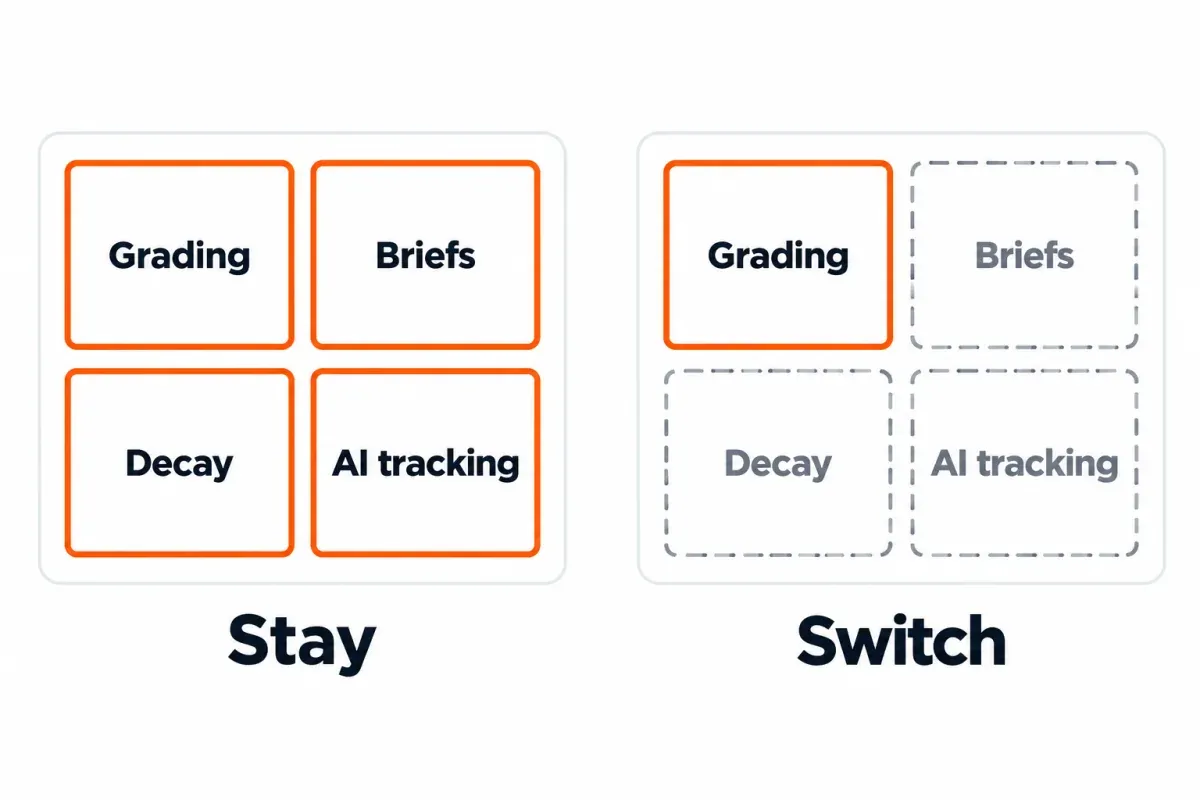
Today's Clearscope does four things. Grade terms in the editor. Brief writers. Watch published pages for decay. Track AI-search visibility. Which replacement fits? Depends on which of those jobs your team actually pays for. Heads up on prices: Clearscope's October 2026 numbers don't match the figures floating around in ranked lists.
Below, each job gets its own section with the Clearscope alternatives worth testing. The math runs for 4, 10 and 30 articles a month. Some switches cut the bill meaningfully. Others don't move it much, and this guide tells you which.
What's the right Clearscope alternative for your job?
Match the replacement to the job your team actually uses, not to the Clearscope bundle as a whole.
| Your job | What Clearscope gives you | Test instead | What changes |
|---|---|---|---|
| Term grading | Content Grade with term suggestions; Google Docs and WordPress add-ons; unlimited writers | Frase for a cheaper single-writer editor with separate SEO and GEO scores; Surfer on Standard for a small team; NEURONwriter for the lowest cost per scored document; Semrush, SE Ranking or Ahrefs if you already pay for the suite | Lower cost per document; different grade and writer workflow |
| Writer briefs | Draft with AI outlines, exported as briefs | MarketMuse for topic models built from your own site; Content Harmony for briefs priced per workflow with unlimited users | Deeper topic research, or pricing by brief instead of by seat |
| Decay monitoring | Content Inventory on Search Console; monthly re-grade; Monday alert email; a 90-day decay view | Search Console plus SEO Heatmap (free for one property); Surfer Content Audit or Frase Content Guard inside an optimizer | Free when you only want to spot pages losing clicks |
| AI-search visibility | Query Tracking across ChatGPT, Gemini and Claude on every plan | Frase, Surfer, Ahrefs or Semrush, when you need more models, more prompts, or daily checks on a bigger set | More coverage or a tighter cadence, at a separate cost |
| You use all four | One subscription | Stay on Clearscope and read the last section | Nothing worth switching for |
I've used Clearscope, Surfer, Frase, MarketMuse and the suite editors (Semrush, SE Ranking, Ahrefs) in-house at SEO Heatmap and on SaaS and content projects I consult for. Content Harmony, NEURONwriter and Dashword are described from their public pages, not hands-on use. Prices and plan limits were checked on each vendor's site in October 2026. SEO Heatmap is our product and covers only the monitoring job, for one Search Console property.
What Clearscope includes in 2026 (and what older lists get wrong)
Shop against the current product, not the one in old write-ups. Clearscope reshaped itself in late 2025 and again in July 2026. Most ranked lists haven't caught up.
Start with Essentials at $129 a month. The allowance: 50 Tracked Queries, 50 monitored Pages, 20 Discoveries, 20 Drafts.1 Business ($399) steps up to 300 / 300 / 50 / 20. Enterprise is custom. Unlimited users and projects on every plan, with a 14-day free trial and no contracts. Monthly credits don't roll over. Extra Drafts cost $5 each on Essentials and $2 on Business; extra monitored pages cost $25 or $15 per 100 a month.
A Draft, formerly called a "report", pulls a live analysis of the top 30 desktop and mobile results. One Draft credit per run, done in a minute or two. You get keyword research and intent in a single view: terms weighted by top-page frequency, audience questions, competitor outlines and the sources worth citing. Draft with AI, on every plan, builds you an editable outline. Intent, content type, tone and title are all adjustable. Export it as a brief, or let the tool carry on into a full draft.
| What older lists say | What Clearscope's pages say today |
|---|---|
| $170 or $189 a month | Essentials $129 since October 2025 |
| 3 seats | Unlimited users and projects |
| "Reports" | Drafts, 20 a month on Essentials and Business |
| No briefs | Draft with AI exports an outline as a brief |
| No AI-search tracking | Query Tracking across ChatGPT, Gemini and Claude on every plan |
Four quick checks on which features your team actually uses, inside Clearscope this week:
- Last month, how many Drafts did your team actually create against that 20-a-month allowance?
- Does anyone open Content Inventory or read the Monday alert email?
- Are any queries configured in Query Tracking?
- Do your writers work in the Google Docs or WordPress add-on, or paste between windows?
If three of those come back empty, you're paying for jobs you don't touch. That's where the switch question starts.
Job 1: term grading in the editor
When teams say "Clearscope", they usually mean term grading. That's the on-page SEO job. Content Grade weights each term 1 to 10 based on top-page usage. Cover more terms, grade climbs.2 AI Term Presence shows which of those terms show up in ChatGPT and Gemini answers. Boost Content Grade inserts unused recommended terms in a click. What the score measures is how closely your copy matches the vocabulary of pages already ranking. It's not an independent judgment of quality. Writers stay in Google Docs via the add-on (it needs a shared Draft, and Workspace admins can block it) or in the WordPress plugin. Every plan allows unlimited writers.
| Tool | Different from Clearscope | Plan you need | Price (basis) | Limit to check |
|---|---|---|---|---|
| Surfer | Content Score, Surfy assistant, one-click optimization | Discovery for the editor; Standard or higher for the Google Docs and WordPress integrations | Discovery $59 a month billed monthly or $49 billed yearly; Standard $119 or $99 | Documents a month on monthly billing: 10 on Discovery, 30 on Standard and Pro; seats 1 / 3 / 5; monthly limits don't roll over |
| Frase | Separate SEO and GEO scores; an agent that drafts and publishes | Any plan | Starter $39 a month annual or $49 monthly; Professional $103 annual or $129 monthly | Articles a month 10 / 40 / 100; seats 1 / 3 / 5; Starter stops at its limit; Professional overage $5 per article |
| Semrush SEO Writing Assistant | Scores SEO, readability, originality and tone; Docs, WordPress and Word add-ons | A higher Semrush SEO tier for unlimited documents (Free and Pro give 2 documents per account) | Semrush's knowledge base lists Guru at $249.95 a month; the newer plans on its pricing page carry different names, so check there | You buy a whole SEO suite to get a grader |
| SE Ranking Content Editor | Brief and editor with Content Score, readability, TF*IDF and keyword placement; Google Docs integration; shareable with people who don't have a subscription | Core or Growth | Comes with the suite plan; we couldn't confirm a USD price on SE Ranking's pricing page | 25 content articles on Core, 50 on Growth; 1 or 3 manager seats |
| Ahrefs AI Content Helper | Grades topical coverage against top-ranking pages; brand kit | Add-on; Ahrefs Free gets 1 document a month | $99 a month for 50 documents; Content Kit $299 for 250 documents plus the AI Content Grader | Inviting team members to a single document is Enterprise-only |
| NEURONwriter | Cheapest scored documents; Search Console, WordPress and Shopify integrations from Gold | Bronze and up; team members and integrations from Gold | Bronze $23 a month or $230 a year; Silver $45; Gold $69 a month | 25, 50, 75, 100 or 150 documents (the page doesn't state the period); "unlimited team members" from Gold only |
One shortcut: if you already pay for Semrush, SE Ranking or Ahrefs, the editor's marginal cost is close to zero. If you don't, you're buying a whole suite to get a grader, which rarely wins unless you need the suite anyway. Dashword runs the opposite play among content optimization tools: scoring is free and unlimited on its Startup plan at $99 a month, and only the 30 content reports use credits, which suits a small team that wants to score many drafts without paying for a suite.
From my own use, in-house and on consulting projects: adoption is the easy part, since the Google Docs add-on keeps writers in their own tool, and the per-report cost is what starts the switching conversation.
What's a better grade actually worth?
Choose the editor on workflow and budget. Don't pick on grade precision.
Here's why. In October 2026, I studied vendor-written B2B SaaS list pages ranking in US Google (both "best X software" queries and "X alternatives" queries) after the September 2026 spam update. In 31 same-SERP pairs (a page in positions 1 to 3 against one in 6 to 10 for the same query), the higher-ranked page missed fewer of the SERP's shared terms in 20 of 31 pairs: median 75 vs 86 missing terms. Keyword density showed no pattern at all. What separated winners more was links to the page itself, an explicit evaluation method with visible evidence, and real freshness.
Those figures are correlation on a snapshot of one page type, with modelled traffic. The reading is not that grading is pointless, and it's not "optimize to 100 and rank": a top grade doesn't secure a top-3 spot. Any of the editors above will tell a writer which terms the top pages share; paying more for a "more accurate" grade buys little. Pick on the job, the workflow and the cost per article.
Job 2: briefs for writers
Some teams use Clearscope mostly to hand writers a research-backed content brief before anyone drafts. Clearscope's Draft with AI builds the outline and exports it as a brief; the underlying Draft analyzes the top 30 results for terms, questions, competitor outlines and citable sources.
MarketMuse is the most different alternative. Briefs come with every paid tier. Optimize gives you 5 a month with 1 user, Research 10 with 3 users, Strategy 20 with 5 users. The briefs draw on topic models plus your own site. Personalized Difficulty and Topic Authority scores sit alongside. No public price list. Optimize, Research and Strategy all funnel into a demo, so expect a sales call, and don't trust the older numbers floating around comparison pages.
Content Harmony sells "workflows" instead: a keyword report, a brief and a grader bundled together. Pricing scales with the workflow count: $50 a month for Standard-5, $99 for Standard-12, $199 for Standard-25, $299 for Standard-50, and up from there. Unlimited users, unlimited projects. Monthly credits stay valid for 90 days.3 For $10, a trial gives you 10 workflows to kick around. It fits a team that briefs a lot and doesn't want per-seat math.
Semrush's Content Toolkit has an SEO Brief Generator, AI articles, brand voices and a Google Docs transfer. The knowledge base lists it at $60 a month, which includes 5 SEO-boosted articles. It's a separate product from the SEO Writing Assistant.
Frase and Surfer also produce briefs inside their editors, on the Job 1 allowances. If briefs plus AI drafts are the whole job, see our Surfer alternatives guide for the brief-to-draft comparison and a two-tool trial template.
Job 3: watching published pages for decay
Most Clearscope alternative lists skip this job, and it's the one with a free route.
Content Inventory hooks into Search Console (one or more properties) and either auto-imports a subdirectory or takes URLs you add by hand. Each page gets a target query and a Content Grade. Re-grading happens monthly. A Monday email summarizes what changed. How Content Decay works: it compares clicks from the last 90 days to the same stretch twelve months earlier. You see the gap as a number and as a percentage, with a 12-month sparkline on the side. You can start a Draft from the view. Essentials covers 50 pages.1 Business goes to 300. Past those caps, extras run $25 or $15 per 100 a month.
If grading moves to Surfer or Frase, monitoring comes in the same subscription. MarketMuse ships its own:
- Point Surfer Content Audit at a page. It pulls your Search Console data, runs a fresh SERP analysis, and loads the result into the editor. Ranking Drop Alerts flag daily rank drops from Standard up. Page tracking allowances by tier: Discovery hits 10, Standard 50, Pro 200, Peace of Mind 500.
- Frase Content Guard flags pages losing clicks or position, offers up a diffed draft of the fix, and ships it once you approve. Page allowances by plan: 10 on Starter, 75 on Professional, 300 on Scale.
- A site inventory with personalized metrics lives inside MarketMuse. Its pricing page says nothing about a Search Console connection.
If monitoring is why Clearscope's bill still looks fine, you can run the same check for free. Four steps:
- In Search Console, open the Performance report and switch to the Pages tab. Set a comparison between the last three months and the same stretch a year back. Then sort by clicks difference, and the biggest losers rise to the top.
- Or try the Pages heatmap in SEO Heatmap. Clicks are broken out by month, week or quarter, and the Falling filter trims the view to pages losing ground. Right away, you can tell which pages are sliding and roughly when the slide started. Top gainers and worst drops get called out by name in the AI insights.
- Don't rewrite the page until you know why it dropped. Our SEO data analysis guide walks through diagnosis before you touch any copy.
- For each page, make the call: keep, update, merge or remove. Our content audit guide covers the call. Grade the rewrite in whichever editor you kept.
Stick to clicks when running year-over-year checks. Search Console's impression numbers were off from May 13, 2025 through April 27, 2026.4 Click data came through fine. You can't cleanly compare impressions, CTR or position across that window. Rankings holding but clicks still slipping? Our organic CTR guide takes on the title-and-snippet side.
SEO Heatmap is free for one Search Console property. You see clicks on the Pages heatmap, no grades, briefs, CTR or position. History goes back the same 16 months Search Console carries. If Content Inventory is the main thing you're paying Clearscope for, shifting that job to Search Console plus SEO Heatmap can mean dropping Business and its 300 monitored pages. Then you pick a grader just on grading.
Job 4: AI-search visibility
Clearscope added Query Tracking in July 2026.5 It's included in every plan, which changes the math on separate AI-visibility trackers.
Query Tracking reports your brand's mention share across tracked queries in ChatGPT, Gemini and Claude (per Clearscope's product page), with up to five competitor domains, a daily rolling average of the 21 most recent responses, a 90-day trend per query, and the three latest responses verbatim. Essentials covers 50 tracked queries, Business 300.
Where does a dedicated tool earn its spot? When you want deeper model coverage, bigger prompt lists, or daily rechecks:
- AI prompt tracking is in every Frase plan. Allowances step up by tier: 20, 50, then 75. Starter covers ChatGPT and Google AI, Professional adds Perplexity, Scale adds Claude and Gemini. Starter keeps 30 days of history.
- Surfer tracks none on Discovery. Standard: 25 prompts, ChatGPT only, weekly refresh. Pro: 50 prompts, all models, daily. There's also a separate AI Search Analytics plan with 50 prompts and daily tracking, at $95 a month or $82 billed yearly.
- Ahrefs runs AI prompt checks in Lite, Standard and Advanced (150, 300 or 600 checks a month). Brand Radar AI starts at $199 a month for brand research across its prompt database, with prompt packages on top. One prompt on one platform in one location is one check.
- Semrush has AI visibility in its SEO + AI Search plans (50 prompts on Starter, 100 on Pro+, checked daily); we couldn't confirm their USD prices.
Tracking mentions is not the same as earning them. Our ChatGPT for SEO guide covers what to do with the tracking data once you have it, and our AI SEO agents guide covers agent-style tools that execute changes. A 2024 study by Aggarwal and colleagues from Princeton and IIT Delhi, presented at KDD, found that generative engine optimization methods can boost source visibility in AI answers by up to 40 percent.6
What each option costs at 4, 10 and 30 articles a month
"Clearscope is expensive" is an argument you can measure. The table below divides each tool's list price by articles a month, monthly billing, USD where confirmed, prices checked October 2026. The arithmetic is ours.
| Volume (1 writer) | Clearscope Essentials | Surfer | Frase | Content Harmony | NEURONwriter | Ahrefs AI Content Helper |
|---|---|---|---|---|---|---|
| 4 articles | $129 → $32.25/article | Discovery $59 → $14.75 | Starter $49 → $12.25 | Standard-5 $50 → $12.50 | Bronze $23 → $5.75 | $99 → $24.75 |
| 10 articles | $129 → $12.90 | Discovery $59 → $5.90 | Starter $49 → $4.90 | Standard-12 $99 → $9.90 | Bronze $23 → $2.30 | $99 → $9.90 |
| 30 articles | $129 + 10 × $5 = $179 → $5.97 | Standard $119 → $3.97 | Professional $129 → $4.30 | Standard-50 $299 → $9.97 | Silver $45 → $1.50 | $99 → $3.30 |
| 3 writers | No change (unlimited) | Standard $119 (3 seats) | Professional $129 (3 seats) | No change (unlimited) | Gold $69 (unlimited team) | Enterprise needed for shared docs |
SE Ranking and Semrush aren't in the table: their graders come inside suite plans, and we couldn't confirm current USD prices on their pricing pages. For a suite you already pay for, the marginal cost of its grader is close to zero. Two footnotes: Surfer's Discovery plan doesn't include the Google Docs and WordPress integrations, and NEURONwriter's page doesn't say whether its document allowance is monthly (the table assumes it is).
The honest version of "price per report hurts": at low volume on one job, yes. At 30 articles a month, Clearscope's cost per draft falls into the alternatives' range, and that $129 also buys 50 monitored pages and 50 tracked AI queries. If a team uses only grading, it's paying for monitoring and tracking that go untouched, which is where the per-report math feels off.
A few caveats before you compare rows:
- One article can use more than one Draft (refreshes, secondary keywords). Scale the volume number first: at 10 articles, Surfer Discovery and Frase Starter are already at their limits.
- Unused Clearscope and Surfer monthly allowances don't roll over. Content Harmony workflows stay good for 90 days.
- Pay annually and the per-month rate drops, with credits delivered upfront.
- Prices exclude tax and change.
A hypothetical worked example (not a benchmark, just arithmetic). A three-writer team publishing 10 articles a month, using grading and decay monitoring:
- Clearscope Essentials covers both for $129, with unlimited writers.
- Frase Professional at $129 covers grading for three seats and brings Content Guard on 75 pages.
- NEURONwriter Gold at $69 plus Search Console and SEO Heatmap (free for one property) covers grading and monitoring for less, at the cost of running two tools instead of one.
When staying on Clearscope is the cheaper choice
A Clearscope alternative isn't always the cheaper call. Stay on Clearscope if:
- Three or four of the four jobs are in play for you. A single subscription beats stitching two or three tools together.
- Access matters for the whole chain: writers, agency partners, freelancers. Unlimited users at $129 or $399 wins against per-seat pricing at Frase or Surfer.
- Adoption's the real bottleneck. Keeping writers in the Google Docs or WordPress add-on has real dollar value. Push them into a second tool and output takes a hit.
- You're publishing 20 to 30 articles a month. The cost per draft on Essentials falls into the single-writer alternatives' range, before you count the monitoring and AI-tracking already bundled in.
Business is a good upgrade if you need the 300 monitored pages or 300 tracked queries. It isn't for more Drafts: Clearscope's pricing page lists 20 Drafts a month on both plans today. Need more drafts? The $2 add-on on Business, or the $5 one on Essentials, usually beats upgrading.
Line up the replacement before you cancel. A half-switched month, writers stuck between two tools, is where production stalls. Pick the replacement first. Jot down the pages you watch in Content Inventory so none drop off the radar, move writers in a single sprint, and cancel at the end of the billing cycle.
Paying for a content optimizer mostly to catch clicks falling? SEO Heatmap pulls that view straight from your Search Console data, free for one property. The Pages heatmap breaks clicks down by month, week or quarter, with a Falling filter and callouts for the pages moving most. No grading, no briefs. Combine it with whichever editor is already working for your writers.
Frequently asked questions
How much does Clearscope cost?
Clearscope lists two self-serve plans on its pricing page today: Essentials at $129 a month and Business at $399 a month, with Enterprise priced on request. Both self-serve plans include 20 Drafts a month and unlimited users and projects, with a 14-day free trial and no contract. Extra Drafts cost $5 on Essentials and $2 on Business.
Is there a free Clearscope alternative?
Not for regular term grading: the free tiers stop at a document or two (Ahrefs Free gives one a month, Semrush's free plan two SEO Writing Assistant documents per account), and the cheapest paid grader covered here is NEURONwriter Bronze at $23 a month. For decay monitoring, yes: Search Console's Performance report (Pages tab with the Compare date filter) and SEO Heatmap's Pages heatmap (free for one Search Console property) show which URLs are losing clicks, which is the job most teams buy Content Inventory to do.
Which is better for content optimization, Surfer SEO or Clearscope?
Team size and setup decide this one. Surfer is cheaper for one writer (Discovery is $59 a month for 10 documents) and covers more AI models on its Pro plan, checked daily. Need access for several people? Clearscope wins. Every plan has unlimited users, while Surfer caps seats at 1, 3 or 5 by plan, and its Google Docs and WordPress integrations only start on Standard.
Clearscope vs Frase: which should I pick?
Per writer, Frase is cheaper. Its editor splits SEO and GEO scores, with an agent that can draft and publish. Content Guard monitors 10 to 300 pages depending on plan. On unlimited writers and bigger monitoring (50 or 300 pages, with a dedicated decay view), Clearscope wins. One or two writers doing the work? Pick Frase. Lots of people needing access? Pick Clearscope.
Clearscope vs MarketMuse: which is better for briefs?
MarketMuse is stronger for brief research built on your own site's topic authority and personalized difficulty, with content briefs on every paid tier. Clearscope's Draft with AI exports a brief inside the same editor your writers already use, with no demo call. MarketMuse has no public price; budget for a sales call before you compare.
Does a higher content grade improve rankings?
It helps as one input, not as a guarantee. In my October 2026 study of B2B SaaS list pages in US Google, term coverage leaned only slightly toward the higher-ranked page in each pair, and keyword density showed no pattern. A top grade doesn't secure a top-3 spot: links to the page, a visible evaluation method and real freshness separated the winners more.
Does Clearscope track AI search?
Yes. Query Tracking launched in July 2026 and is included in every plan, with 50 tracked queries on Essentials and 300 on Business. It reports brand mention share across tracked queries in ChatGPT, Gemini and Claude (per Clearscope's product page), with up to five competitor domains and a 90-day trend.
Can I monitor content decay without a content optimizer?
Yes. Head into Search Console's Performance report, click the Pages tab, and set a comparison between the last three months and the same window a year back. Then sort by clicks difference to see which URLs took the biggest hit. On SEO Heatmap's Pages heatmap, free for one property, you get the same view over 16 months, with a Falling filter and AI insights for your top losers. Lean on clicks for year-on-year checks. From May 13, 2025 to April 27, 2026, Search Console's impressions logging was off; clicks were fine.
Before you renew a content optimizer for its monitoring alone, connect Search Console to SEO Heatmap and watch which pages have been losing clicks, month by month or week by week. It's free for one property.
Sources (6)
SEO Heatmap Knowledge relies on primary sources: Google's documentation, web standards, peer-reviewed research, and vendors' own pages for their pricing and features. Our editorial standards
- Clearscope. “Pricing.”
- Clearscope. “How does Clearscope grade your content?”
- Content Harmony. “Pricing.”
- Google Search Console Help. “Data anomalies in Search Console.”
- Clearscope. “Introducing Query Tracking: Measure and Grow Your Brand Visibility Across ChatGPT, Gemini, and Claude.”
- Aggarwal et al., KDD 2024. “GEO: Generative Engine Optimization.”