Summarize this article with AI
Pretty much every SEO vendor sells an AI SEO agent now. The product pages all promise the same deal: hand us your SEO, get results. Read a few closely. A few in, you notice the pitches arguing with themselves, sometimes on the same page. The hero headline up top? It sells autonomy, as in the agent fixes things on its own. Then the FAQ further down walks it back to recommendations. Hero copy and fine print saying different things. That's where buying decisions go sideways.
This guide skips the ranked list. Instead, the agents are grouped by what you need done: briefs and drafts, content refresh, on-page and technical fixes, monitoring and reports, or build-your-own. Grading uses one four-step autonomy scale, with a note on where its numbers come from and the "from" USD price when the vendor's own site shows one. There's also a sales-call question list, a cost-per-finished-task calculation, and a two-week pilot. The quick-pick table comes first.
Which AI SEO agent fits your job?
Give an AI SEO agent a goal. From there, it reads your connected tools, chains a few steps, and comes back with finished work. Could be a brief. Could be a draft, a fix, or a report. For most products here, a human still signs off before anything ships. The ones that act alone mostly do so because you switched that on.
The job decides. Not a vendor's leaderboard. The table below groups the agents named in this guide by job, then grades how much each one does on its own, where its numbers come from, and how it is priced. Prices are "from" numbers in USD on each vendor's own site in October 2026; where we couldn't confirm a USD price, the table says so.
| Job | Agents to look at | How much it does alone | Data it works from | Pricing model (from, Oct 2026) |
|---|---|---|---|---|
| Content research, briefs and drafts | The SEO Agent, Frase, Writesonic, Surfer | Drafts for approval; Frase auto-publish is opt-in | Search Console + live SERP (The SEO Agent); live SERP (Frase, Surfer); GA + Search Console + SERP (Writesonic) | $99/mo for 30 articles (The SEO Agent); from $49/mo (Frase); from $79/mo billed yearly (Writesonic); check the current price (Surfer) |
| Content refresh and decay recovery | Frase Content Guard, Surfer Rank Drop Detection, Letaido refresh lists | Drafts for approval by default | Live SERP, rankings per page, Ahrefs' index | Inside the plans above; Letaido $99/mo on top of an Ahrefs plan |
| On-page and technical fixes | Alli AI, Letaido with Ahrefs Site Audit, Nightwatch and Semrush as recommenders | Alli AI deploys at scale; Letaido opens a pull request a developer merges | Own crawl (Alli AI); Ahrefs' index (Letaido) | From $299/mo (Alli AI); $99 + an Ahrefs plan (Letaido) |
| Rank and AI-answer monitoring and reports | Nightwatch SEO AI Agent, Letaido scheduled reports, Semrush AI Visibility Toolkit, Ahrefs Brand Radar | Reads, reports and alerts; fixes are a separate job | Own rank tracker; AI-answer sampling; own index | Nightwatch metered in agent credits (check the current price); Semrush AIVT $99/mo; Brand Radar from $199/mo |
| Build your own | Chat assistant + MCP (ChatGPT, Claude, Claude Code), Gumloop, n8n, Relevance AI | Whatever you set | Whatever you connect: Search Console, GA4, SEO Heatmap for page clicks, vendor MCP servers | From $37/mo (Gumloop); n8n metered by executions; Relevance from $19/mo billed yearly |
No single product covers every row well. Most teams have one job that eats their week. Start there.
What counts as an AI SEO agent?
An AI SEO agent takes a goal (write a brief for keyword X, audit the site this month), reads from the tools you've connected, picks its own steps, and hands back finished work. A plain AI writer? It just turns a prompt into text. Chat assistants reply one turn at a time, until you connect data and hand them a multi-step job. You will also see the terms "SEO AI agent" and "agentic SEO" for the same idea.
Many products sold as agents are not agents by this definition. Content editors like Clearscope, writing platforms like Jasper or Copy.ai, and suite modules with "AI recommendations" buttons are useful; they just do not chain steps and come back with a deliverable. Plenty of what gets sold as an "AI SEO tool" is an AI writer with a keyword field.
The useful question is not "is this an agent," it is "how much does it do on its own?" Grade every vendor's marketing on the same four-step scale.
| Level | What it means | Examples from vendor pages |
|---|---|---|
| 1. Recommends | Finds issues and suggests fixes; you do the work | Semrush Site Audit; SE Ranking; Nightwatch's FAQ wording ("clear recommendations") |
| 2. Drafts for approval | Produces the deliverable (draft, fix, pull request); a human approves | The SEO Agent ("nothing publishes until you say so"); Frase Content Guard republishes on approval; Ahrefs' agent (now Letaido) opened a pull request a developer merged |
| 3. Acts within limits you opt into | Scheduled reports, alerts, or auto-apply once switched on | Frase's opt-in auto-publish; Letaido scheduled automations |
| 4. Deploys to the live site at scale | Changes ship across pages without a per-change step | Alli AI (titles, meta, schema, internal links across the whole site through a plugin or snippet) |
Two things to watch. One, a vendor can sit on two levels at once: it recommends by default, and acts when you flip a switch. Two, the hero copy and the FAQ further down don't always tell the same story. Nightwatch's hero copy says the agent "implements optimizations automatically"; its own FAQ says it "helps you resolve them quickly with clear recommendations." That is a question to ask on the sales call, not a detail to guess at.
AI SEO agents by the job you need done
For each agent below, four facts in the same order: what it does on its own, what still needs your approval, where its numbers come from, and how it is priced (the "from" price and the unit it meters by). A vendor shows up in full once, in its main job. These are documented capabilities from each vendor's own product and pricing pages in October 2026, not results from our own tests of every product. Prices are the USD prices each vendor shows; where we couldn't confirm one, you get the unit it meters by instead of a number.
Content research, briefs and drafts
The SEO Agent (theseoagent.ai). The autonomous bits: keyword research, a 30-day content plan, drafts, live-SERP fact-checking, images, and publishing straight to WordPress, Webflow, Shopify, Ghost, Wix or a webhook. You still approve everything that ships. Their own line: "nothing publishes until you say so" and "weak drafts stay unpublished". Where the numbers come from: your Search Console (pages, queries, clicks, impressions) plus the live SERP. $99 a month gets you one site and 30 articles.1 Extra sites run $79/month. The trial costs $1.
Frase. What runs itself: keyword and SERP research, briefs, drafts scored for SEO and GEO, content audits, AI-visibility tracking (ChatGPT and Google AI on Starter, Perplexity on Professional, Claude and Gemini on Scale), plus decay detection and fixes via Content Guard. Publishing waits on your approval by default; auto-apply is an opt-in switch. Data: live SERP, your AI-visibility prompts. Access: a read-write MCP server and CLI on every plan. Starter runs from $49/month ($39 billed yearly) for one seat, one site, 10 articles and 50 audit pages a month, with Content Guard on 10 pages.2 Professional is $129 ($103). Scale, $299 ($239).
Writesonic SEO AI Agent. On its own: SERP analysis, competitor research, content planning, technical audits, meta tag, schema and internal-link suggestions. For your approval: changes to your site; its "Agentic Workflows" are capped on Starter (10 trial runs) and Growth (100 trial runs plus an Action Center trial of five off-page and five on-page actions a month), with full access on Enterprise. Data sources: Google Analytics, Search Console, and the live SERP. Starter is $79 a month on annual billing, $99 month-to-month.3 Basic is $199. Growth is $399 billed yearly.
Surfer. Running without you: Content Editor scoring against the SERP, Surfer AI drafts, "1-click" content optimization, rank-drop alerts, and cannibalization reports. You still approve every change ("1-click" meaning you do the clicking). Data: live SERP. MCP access shows up on higher plans. Pricing: check the current price on Surfer's pricing page; plans cap content documents and AI prompt tracking by tier.
Test it with: a keyword where you already rank. Ask it for a brief or a draft, lay it next to your live page, and tally the facts you had to correct or throw out.
The honest tradeoff? Per-article caps set the real cost, not the sticker price. And every draft still needs an editor. If briefs and drafts are the whole job, our Surfer SEO alternatives guide compares five tools for that handoff in more depth. The usual way these fall over is generic AI content, and Google's spam policies list using generative AI to churn out many pages without adding value as an example of scaled content abuse.4 They're strongest on data you can verify yourself: your Search Console, your pages, the live SERP. Reach further than that, and they fill in with guesses.
Content refresh: finding and fixing pages that are slipping
Frase Content Guard. Watches pages, proposes the fix, republishes on your approval; auto-apply opt-in. On Starter it covers 10 pages.
Surfer Rank Drop Detection. Flags pages that lost rankings; deciding what to change, and changing it, is still on you.
Letaido (Ahrefs). Builds refresh lists from Ahrefs' data (Ahrefs' own write-up on SEO agents describes a refresh finder). The shortlist is the agent's; the rewrite is yours.
Before any of this, you need to know which pages are losing and when the slide started. That's what SEO Heatmap shows. Each page's clicks on a heatmap, 16 months by month or 16 weeks by week. Filters surface the growing URLs and the falling ones. AI insights flag your top gainers and losers. Claude and ChatGPT can read it over MCP, and it's free for one Search Console property. That's not an agent. It's the data source an agent (or you) works from.
Test it with: one page you already know dropped. Does the agent find it, and does its reason match the click data?
On-page and technical fixes
Alli AI. Writes titles, meta, schema and internal links, and ships "AI-readable structure" across the whole site through a WordPress plugin, a JavaScript snippet or a tag manager. It's the one Level 4 tool here. It deploys at scale. The pricing page doesn't say whether each change is reviewable before it ships. Push that to the top of your sales-call list. Business runs $299/month month-to-month, or $2,990 billed annually. Agency is $599/month, or $5,990 billed annually. Enterprise pricing comes after a demo request. Trial lasts 10 days.
Letaido (Ahrefs' agent platform, launched as Agent A). Reads straight from Site Explorer, Keywords Explorer, Site Audit, Rank Tracker and Brand Radar; writes to Notion, Slack, HubSpot and WordPress.5 The published example is Site Audit flagging an issue, the agent opening a pull request with a code fix on the site's GitHub repo, a developer merging it, and the agent re-crawling to confirm. Pricing: $99/month on top of an Ahrefs plan (Lite from $129/month; Standard $249; Advanced $449; Enterprise $1,499). Ahrefs' own MCP is in both the ChatGPT apps directory and the Claude connectors directory.
Nightwatch, Semrush Site Audit, Writesonic audits. All at Level 1 for this job: they find and recommend, you fix.
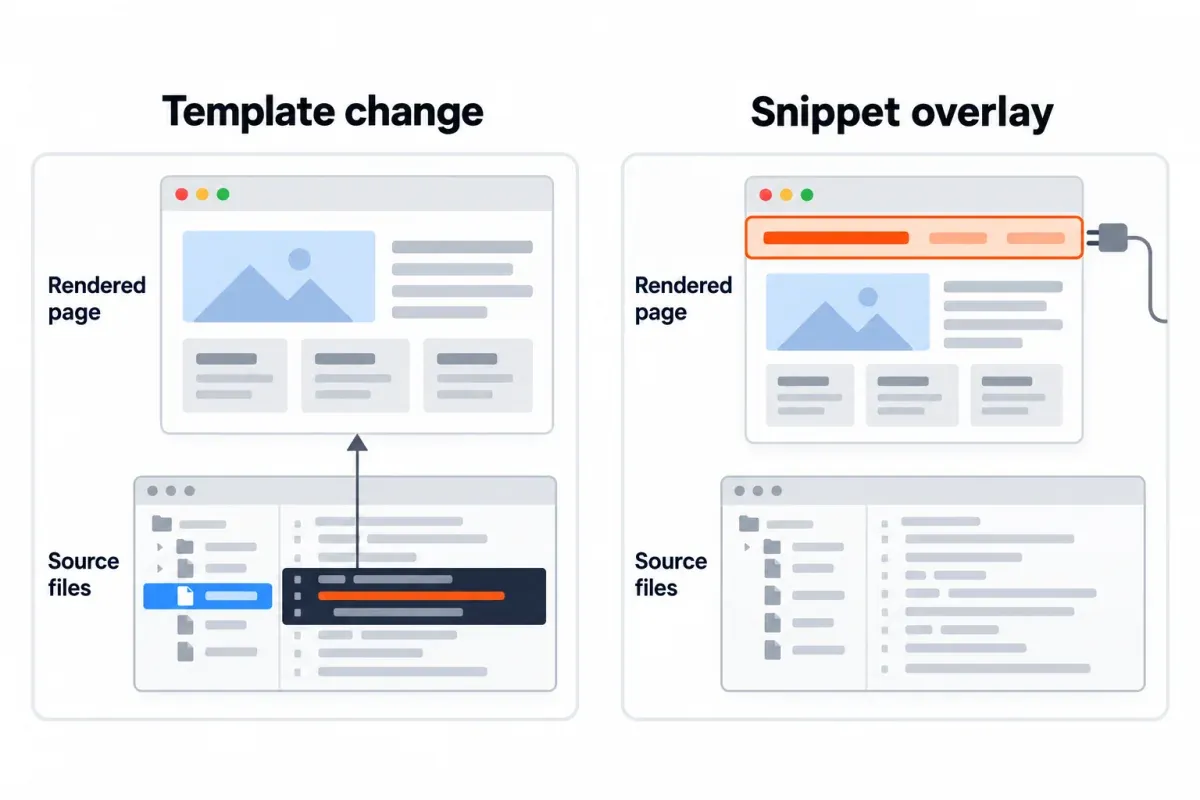
Test it with: a staging site, or a batch of pages you can roll back. After that, ask how a bad change gets undone, and whether the "fix" lands in your templates or sits on top as an overlay.
Here's the tradeoff worth naming. A change injected by a snippet isn't the same as a change in your templates. Both are legitimate. What changes is who owns the fix, and how fast you can roll it back when something breaks.
Rank tracking, AI-answer monitoring and reports
Nightwatch SEO AI Agent. Keyword research, technical audits, content suggestions, rank tracking and competitor monitoring, with AI-answer tracking as part of the plan. Data: Nightwatch's own rank tracker (Google, YouTube, Bing) and Google Analytics. The agent is included in every plan and metered in SEO Agent credits (Starter: 100 a month; Professional: 1,000; Agency: 5,000).6 An MCP server runs on every plan. Check the current price on Nightwatch's pricing page.
Letaido scheduled reports. Automations that run without you: a monthly performance report, a weekly competitor-gap feed, alerts. Covered by the $99/month Letaido price above.5
AI-answer visibility. Semrush AI Visibility Toolkit at $99/month (tracks Google AI Mode and ChatGPT); Ahrefs Brand Radar from $199/month; SE Visible, SE Ranking's separate AI-visibility product; Surfer's AI Tracker. Tracking tells you where you show up; for the content side of getting cited, see our ChatGPT for SEO workflow.
Test it with: one week of alerts. Count how many led to action and how many were noise.
Reports and alerts are the safest job to hand to an agent: it reads, it does not change the site.
Should you build your own SEO AI agent?
Three routes to consider, lightest to heaviest.
| Route | Best for | Setup | Main limit | Cost (from, Oct 2026) |
|---|---|---|---|---|
| Chat assistant + MCP | A one-person job you repeat weekly: a refresh shortlist, a brief, a cluster | ChatGPT, Claude or Claude Code with MCP connectors for your SEO tools and Search Console | Each MCP exposes a subset of its tool's data; a local agent stops when you close the laptop | Whatever you already pay for the chat and the tools |
| No-code builder | A workflow a team runs on a schedule and can hand off | Gumloop, n8n or Relevance AI; wire in Search Console, GA4, Semrush or Ahrefs through native integrations or MCP, pick a model | Builders that work with every model know no SEO out of the box, so the SEO logic is on you | Gumloop Pro from $37/month (20k credits); n8n metered by executions, free self-hosted Community edition; Relevance Pro from $19/month billed yearly ($29 monthly), 2,500 actions |
| Agent platform from an SEO vendor | A team that already lives in one vendor and wants its data and dashboards | Letaido on Ahrefs' index; Lyzr Skott for broader marketing teams | Locked to one vendor's data and worldview | Letaido $99/month on top of an Ahrefs plan; Lyzr: check the current price with the vendor |
Gumloop's author has a line worth keeping. An AI workflow runs through rigid steps you set. An agent gets to make decisions for you. Most SEO work needs the workflow, with maybe a decision point or two tucked inside.
Build when the job hinges on your particular site setup, when your data already sits in paid tools, and when someone will keep the workflow alive after it breaks. Buy when it's standard work (briefs, monitoring, refresh shortlists) and nobody's sticking around to look after a custom build. If you go the chat-assistant route, our guides on picking the data server (our SEO MCP guide) and running SEO work on Search Console data (our Claude SEO workflows guide and our Google Search Console MCP guide) pick up where this section stops.
Where AI SEO agents save time, and where they don't
A Reddit thread in r/n8n asks it bluntly: do AI SEO agents actually work? The short answer? Yes on the jobs below, no on the ones sitting right next to them.
| Works well today | Fails or disappoints |
|---|---|
| Sequential, data-heavy, repeatable jobs: keyword clustering, audit triage, refresh shortlists, internal-link suggestions | Numbers it was not given: invented keyword volumes, backlink counts, rankings that do not exist |
| Recurring reports and alerts: monthly performance roll-up, competitor gap feed, Search Console drops | Unedited generic content: a draft shipped as the final piece |
| Turning a found issue into a reviewable fix: a Site Audit flag that becomes a pull request a developer merges | Automating the whole pipeline at once: research to publish with nobody reading in the middle |
| Work on your own data: your Search Console, your pages, the competitors you chose | Jobs where the agent only sees a subset of the tool's data through a thin MCP |
Hidden caps change the math too. What looks like a flat subscription is actually metered. Nightwatch Starter gives you 100 agent credits a month.6 Writesonic Starter caps agentic workflow trial runs at 10.3 The SEO Agent allots 30 articles a month, Frase Starter 10.
One practitioner number, offered as one person's experience and not a benchmark: Gumloop's author says eight hours of their work now takes two to three. Your mileage depends on the job you pick, and the editor time still eaten by the output.
In practice? Start with one job. Keep the approval step on. Measure how much of the output you actually keep.
How we run this blog with a chain of agents
This blog is produced by a chain of agents. The first agent researches the keyword and the pages ranking for it already. Another drafts. A separate editor with fresh context reads the draft cold, the way a reader would. Another picks and verifies the sources that get cited. A script generates the structured data. A person picks the topic and the angle, answers the agents' open questions, and reviews the images before anything ships.
Four lessons from running it:
- Give each agent one narrow job. A narrow job is easier to audit, and easier to rerun when it goes sideways.
- Have a second agent review the first one's work with fresh context. Trust the first pass and you'll ship invented facts and rephrased filler without noticing.
- A human still owns the decisions that matter: topic, angle, what actually ships. The chain does the labor. The human owns the call.
- Every run has its own log, which lets you rerun a single failed step without redoing the whole chain. When one agent whiffs, you rerun that step and nothing else.
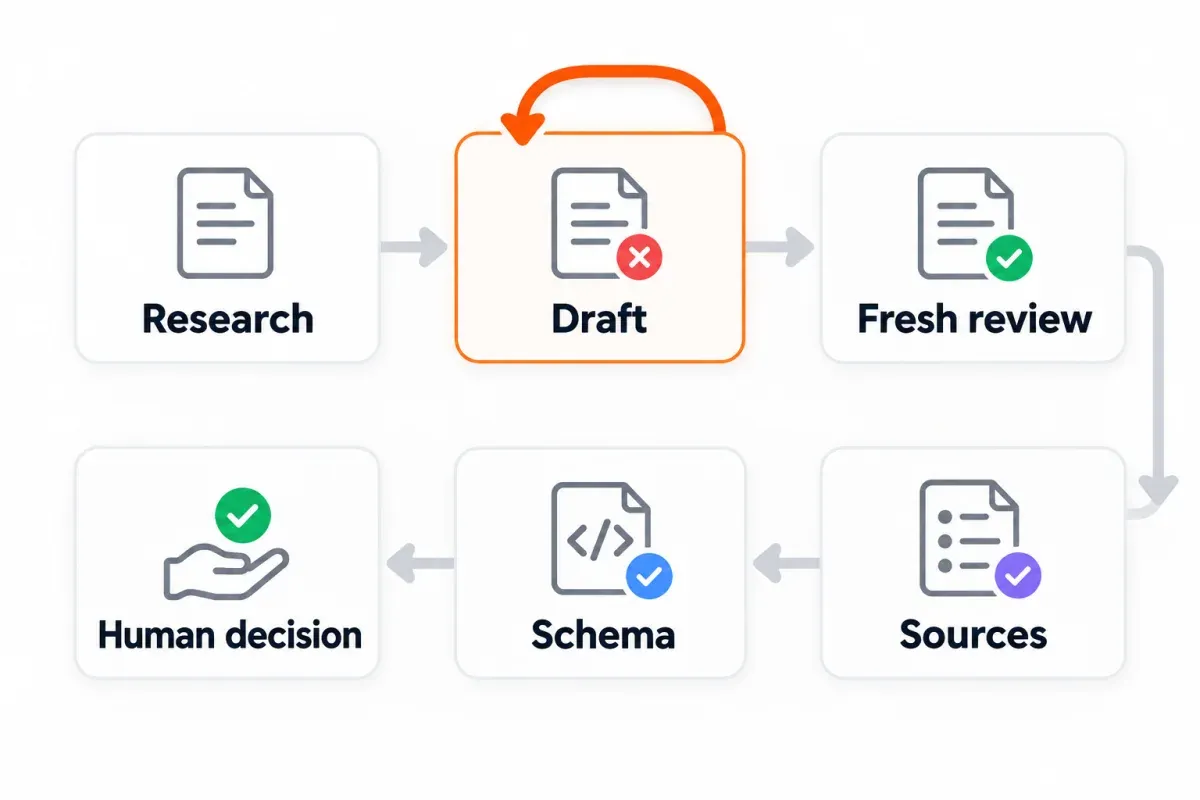
One concrete example from this article. Our content plan said this keyword had a difficulty of zero; when the first step rechecked it live, the difficulty was 22. Still worth writing. Just a different call than the one the plan originally pointed at. That's why the chain re-pulls the numbers at the start instead of relying on a snapshot from weeks or months back. The research step also caught that the Ahrefs agent page now redirects to a renamed product (Letaido), which only a check of the vendor's own page would surface.
You don't need a 90-day rollout for any of this. Start with a job you already know well. Add the next job once the first one gets boring.
Six questions to ask before you buy an AI SEO agent
Six questions. Each one has a reason behind it, and an answer shape worth listening for.
- What does it change without my approval, and can I switch that off? Why: hero copy and FAQ often disagree (see Nightwatch above). A good answer names the opt-in actions, shows you a per-change log, and points at the kill switch.
- Where do its numbers come from, and can I spot-check one? No real data, no real answers. An agent without connected data will fill the gap with plausible fakes. Good answer: a Search Console click count, a ranking or a backlink count that still matches when you check the source yourself.
- How do I check its work? Why: anything you can scrutinize (diffs, pull requests, change logs, drafts you approve) holds up. A background job that "optimized your site" doesn't. Good answer: a review step you can run through before a change ships.
- What does one finished task cost once the caps and add-ons are counted? See the cost math below.
- Whose infrastructure does it run on, and can I export what it made if I leave? Reason to ask: most SaaS agents live on the vendor's infrastructure. Some teams need the content, briefs, or audit history out in a format they actually own.
- Which single job will I hand it first? You ask because automating everything at once is where teams tend to waste the most money. The answer should be short. One job. One data source. One approval step.
Cost per finished task (illustrative)
The sticker price is not the cost. The metering unit is. A worked example with confirmed prices:
- Frase Starter: $49/month, 10 articles. At the cap, that is $4.90 per article. If you keep six out of 10 after editing, it is about $8.17 per kept article.
- The SEO Agent: $99/month, 30 articles. $3.30 per article at the cap, same arithmetic.
- Letaido runs $99/month on top of an Ahrefs subscription (Ahrefs plans begin at $129/month). Whatever you asked for counts as a "finished task" here. A monthly report. A site-audit pull request. A refresh shortlist. Then divide by the tasks you actually ran that month.
- Nightwatch meters in agent credits. The Starter plan comes with 100 of those a month. Ask the rep how many credits one of your typical tasks eats, and work out the per-task cost from there.
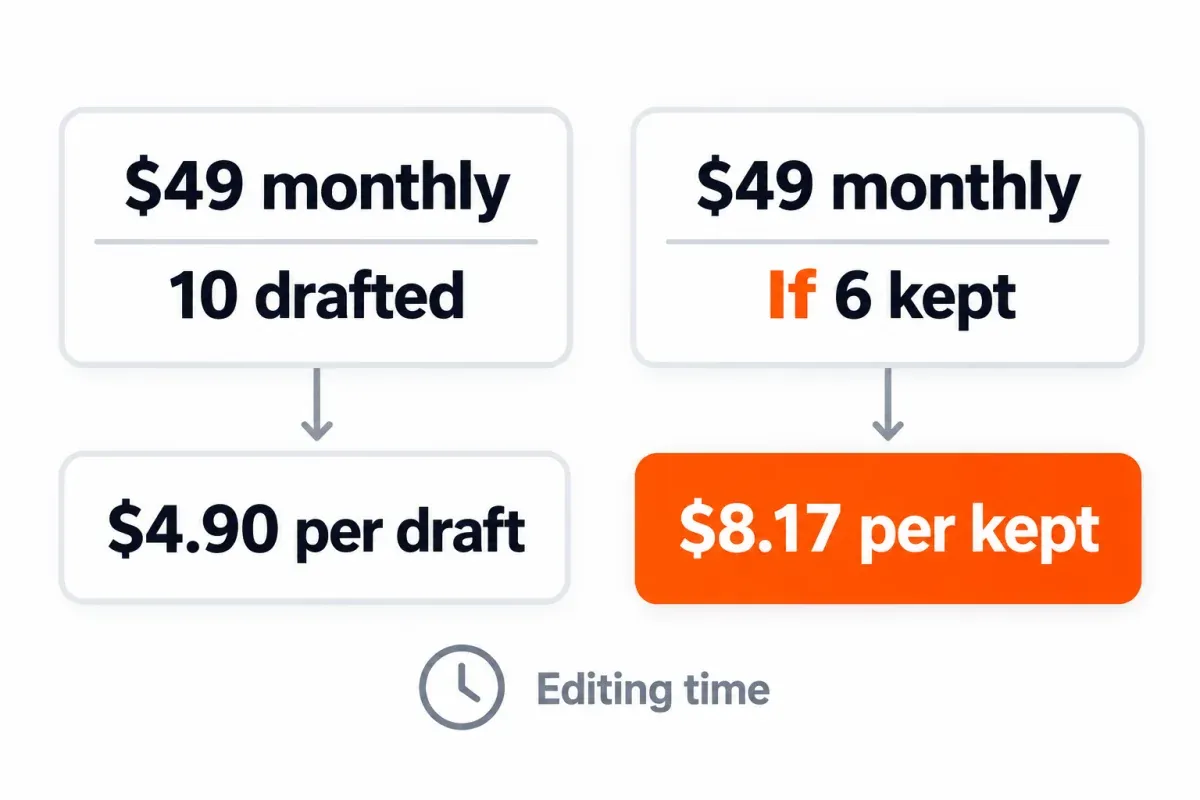
Then add your editor's time. That's usually the bigger line.
Running a two-week pilot
- On day 1, pick one job and connect real data (your Search Console, existing pages, Google Analytics). Approval step stays on.
- Days 2 through 7? Let the agent work. Note what you kept untouched, what you rewrote, and what hit the trash.
- Day 8: hold the output up against what you'd have produced by hand in the same stretch.
- Days 9 through 14: if the agent held up, bring on the second job. And if it didn't deliver, swap the job before you swap the tool.
Pretend the first job is "find the pages whose clicks are falling, in order." You already have that data sitting in Search Console.
Picking an AI SEO agent for refresh or monitoring work? Know which pages are gaining clicks and which are losing them first, before you hand anything to an agent or a person. SEO Heatmap handles exactly that part, and it's free for one Search Console property. 16 months of per-page clicks on one heatmap. Filters for growing and falling URLs. AI insights calling out your top gainers and losers. Read access from Claude or ChatGPT over MCP. Hook up your property, look at the past 16 weeks, and the first job to hand off becomes obvious.
Frequently asked questions
Does an AI SEO agent replace an SEO specialist?
No. They do their best work on sequential, data-heavy stuff. Clustering. Audit triage. Refresh shortlists. Internal-link suggestions. Reports and alerts. The judgment calls stay with you. What to publish, which fix is worth the engineering time, when a drop is just a seasonal dip.
Will an AI SEO agent change my site without my approval?
Most don't out of the box. Some will if you opt in. One tool is built specifically to deploy at scale. The SEO Agent publishes, and Frase Content Guard republishes, only once you've approved the change. Frase has an opt-in auto-apply switch. Ahrefs' Letaido can open a pull request your developer merges. Alli AI pushes titles, meta, schema and internal links across the entire site via its plugin or snippet. Before you buy, ask which actions run without approval and where the switch is to turn them off.
Where does an AI SEO agent get its data?
It depends on the agent, and that is the first question to ask any vendor. The SEO Agent and Writesonic connect to your Search Console (and Writesonic to Google Analytics too); Frase and Surfer read the live SERP; Letaido reads Ahrefs' own index; Nightwatch uses its own rank tracker and AI-answer sampling; Alli AI runs its own crawl. An agent that can't name its data source is probably filling the gaps with guesses that only look plausible.
What does an AI SEO agent cost?
Sticker prices run $19 to $300 a month for most products, with enterprise plans above that. The better question is what gets metered. The SEO Agent runs $99 a month for 30 articles. Frase Starter is $49 for 10 articles and 50 audit pages. Letaido is $99 on top of an Ahrefs plan (from $129). Alli AI starts at $299. Both Nightwatch and Gumloop meter in credits, which can run dry mid-month when you underestimate usage. Take the plan price and divide by the finished tasks you actually keep. Then add your editor's time, usually the bigger line.
Is an AI SEO agent just an MCP server?
No. An MCP server is a connector. Through it, a chat assistant or an agent reads (and sometimes writes) data from one specific tool: Search Console, Ahrefs, Frase, Nightwatch, Semrush or SEO Heatmap. An AI SEO agent sits on top of those servers, pairing them with models and prompts so it can chain steps and return a deliverable. You need the servers to feed an agent real data. On its own, the server isn't an agent.
Build an SEO agent, or buy one?
Go the build route when the job depends on how your specific site is laid out, when the data you need already lives in paid tools, and when someone on the team will keep the workflow running after it breaks. For standard work (briefs, monitoring, refresh shortlists), buy, especially if no one in-house wants to maintain a custom build. There's a middle route a lot of teams land on. Hook a chat assistant like Claude or ChatGPT up to Search Console and your SEO tool through MCP. Cost is whatever you already pay for those services.
Can an AI SEO agent help with AI Overviews and ChatGPT visibility?
They can track where you show up in AI answers. Some can also write content aimed at getting quoted there. Semrush AI Visibility Toolkit ($99/month) covers Google AI Mode and ChatGPT. Ahrefs Brand Radar starts at $199/month. Frase monitors ChatGPT and Google AI on Starter, with Perplexity, Claude, and Gemini on higher plans. Surfer has its own AI Tracker. That's tracking, one job. Getting cited in AI answers is a separate job, and it still comes down to good content on the topics people actually ask about.
How technical do you have to be to run an AI SEO agent?
For purpose-built products like The SEO Agent, Frase, Writesonic, Nightwatch and Alli AI, setup is mainly a signup plus one connection. The connection goes to your Search Console, your CMS, or (in Alli AI's case) a plugin or snippet on the site. The build-your-own route (Gumloop, n8n, a chat assistant plus MCP) asks you to be comfortable wiring tools together and reading an API doc now and then. The skill that decides it, either way, is reading the agent's output skeptically. The tool side is the easier half.
Before you hand any of these jobs to an agent, know which pages are gaining clicks and which are losing them. SEO Heatmap puts every page's Search Console clicks on one heatmap. The slipping pages and the rising ones jump out at a glance. Free for one property.
Sources (6)
SEO Heatmap Knowledge relies on primary sources: Google's documentation, web standards, peer-reviewed research, and vendors' own pages for their pricing and features. Our editorial standards
- The SEO Agent. “The SEO Agent: Pricing.”
- Frase. “Frase: Pricing.”
- Writesonic. “Writesonic: Pricing.”
- Google Search Central. “Spam policies for Google web search.”
- Ahrefs. “Letaido: AI Agents for Marketing Built by Ahrefs.”
- Nightwatch. “Nightwatch: Pricing.”