You’re not fixing an error; you’re deciding whether to touch an indexing system that can deindex revenue pages if you guess wrong. In audits, this is one of the most misdiagnosed Google Search Console statuses—because it often means “everything is fine.”
I’ve worked hands-on with index coverage and canonicalization issues across ecommerce and content sites, and I built this guide by reviewing what currently ranks, cross-checking with Google’s documentation, and turning the advice into a workflow you can actually run in GSC + a crawl.
Outcome: you’ll decide ignore vs fix, identify the root cause pattern, apply the smallest safe fix, and validate that Google is indexing what you intend.
Plain-English definition: “Alternate page with proper canonical tag” means Google found a URL that it considers a duplicate/variant, and it’s choosing a different URL as the canonical (often the one you specified).
Quick answer (first thing to verify): pick 5–10 sample URLs from the report and check in URL Inspection whether Google-selected canonical = your intended canonical. If yes, it’s usually OK.
Who this guide is for (and who it’s not)
This is for: beginner–intermediate SEOs who need to triage GSC indexing statuses without accidentally removing important pages from the index.
Not ideal for: teams that need log-file-level crawl budget modeling or custom canonicalization logic in a headless stack (you’ll still benefit from the decision framework, but you’ll likely go deeper).
How this guide was built (method + what to verify on your site)
Method I used to derive the workflow:
- Start from how Google describes canonicalization and indexing signals.
- Translate that into a practical audit sequence: GSC export → sample inspection → pattern detection → signal alignment checks.
- Prefer “smallest effective fix” (change one signal at a time) to avoid unintended deindexing.
What you must verify on your own site (because I can’t):
- Whether the affected URLs are intended to be indexed (business intent)
- Whether canonicals are consistent across templates
- Whether internal links/sitemaps are reinforcing the wrong URL
- Whether parameters/facets are generating near-infinite URL variants
Decision framework: is this status OK or a problem?
Answer one question first:
Do you want this URL indexed?
Use this quick decision tree:
- If NO (it’s a variant/duplicate):
- Status is usually OK.
- Your job is to ensure Google is canonicalizing to the right URL and that variants aren’t exploding crawl waste.
- If YES (it’s a valuable landing page):
- Status is a problem.
- Your job is to find which signal is telling Google “this is not the main page” and correct it.
Common mistake: Treating the report like a list of “errors to fix.”
Do this instead: Treat it like a canonicalization audit queue: confirm intent → confirm canonical selection → fix only mismatches.
Fast triage checklist (10 minutes)
Pick a small sample (5–10 URLs) from the report and do this:
- URL Inspection → Page indexing
- Note: User-declared canonical vs Google-selected canonical
- Open the page HTML and confirm:
<link rel="canonical" href="...">exists and is the intended URL
- Check whether the canonical target:
- returns 200 OK
- is indexable (not blocked/noindexed)
- is not a redirect chain
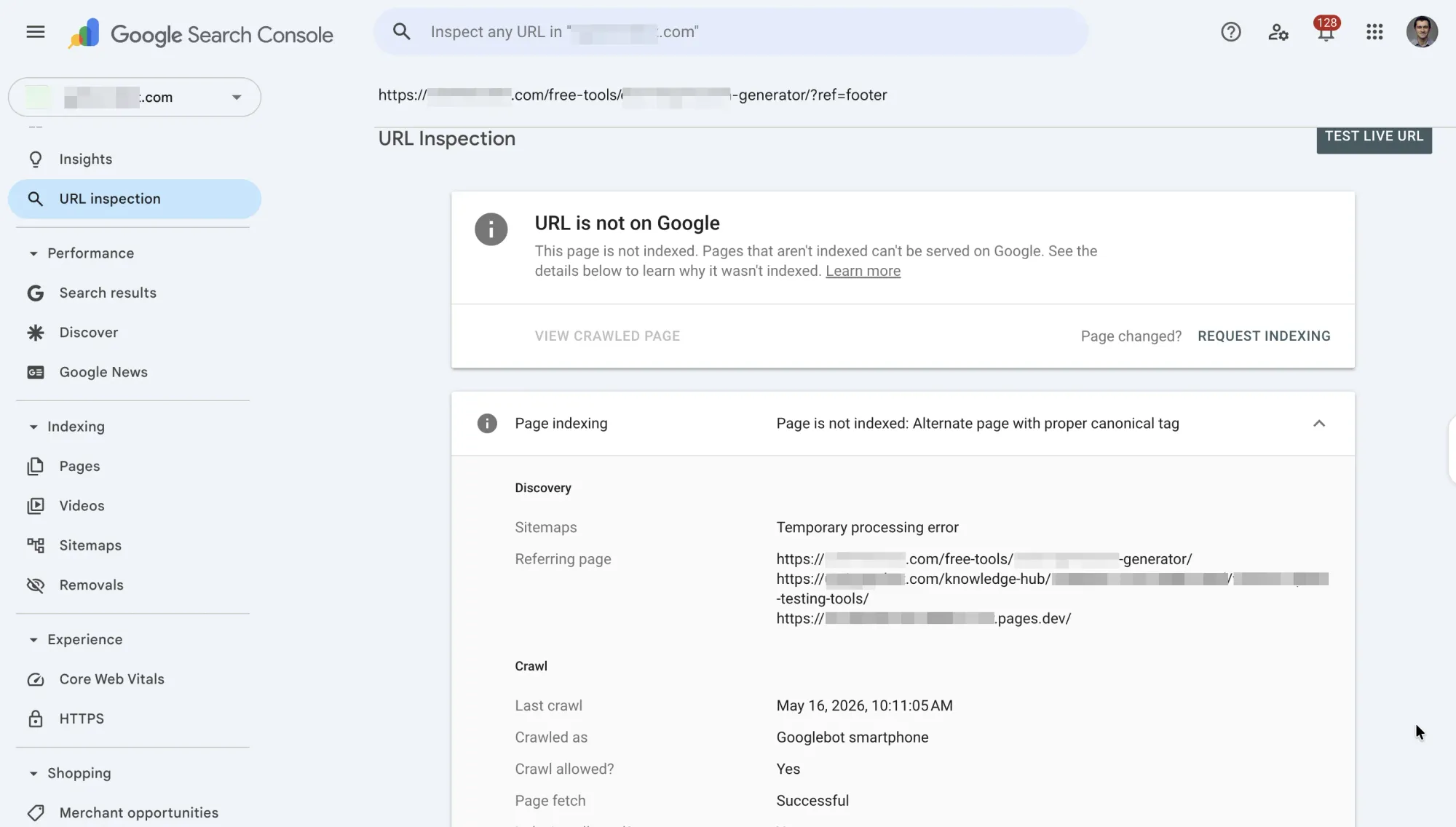
If Google-selected canonical matches your intent for most samples: likely OK.
If Google-selected canonical differs from intent: proceed to diagnosis.
What “Alternate page with proper canonical tag” actually means (in GSC terms)
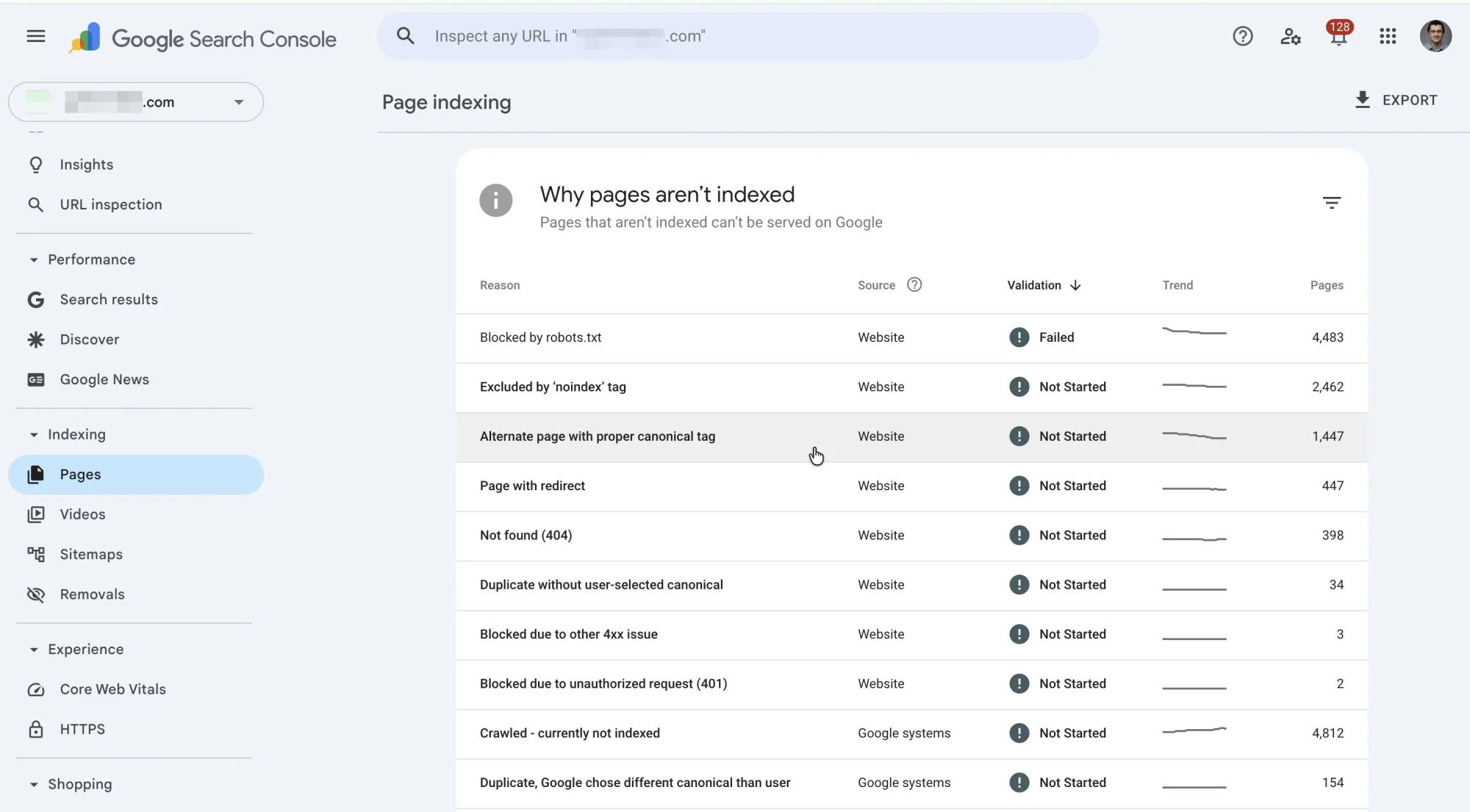
GSC is telling you:
- Google discovered a URL.
- Google believes it’s an alternate (duplicate/near-duplicate) of another URL.
- The alternate URL has a canonical pointing elsewhere (often correctly).
- Google is therefore not indexing the alternate URL.
Two important nuances:
- Canonical tags are a signal, not a guaranteed command in all cases.
- Google uses multiple canonical signals (not just the tag): internal links, sitemaps, redirects, content similarity, and more.
Step-by-step workflow (GSC → patterns → smallest safe fix)
This is the repeatable process I use.
Step 1: Export the report and build a quick pivot
In GSC:
- Go to Indexing → Pages
- Click the status: Alternate page with proper canonical tag
- Export URLs (CSV/Sheets)
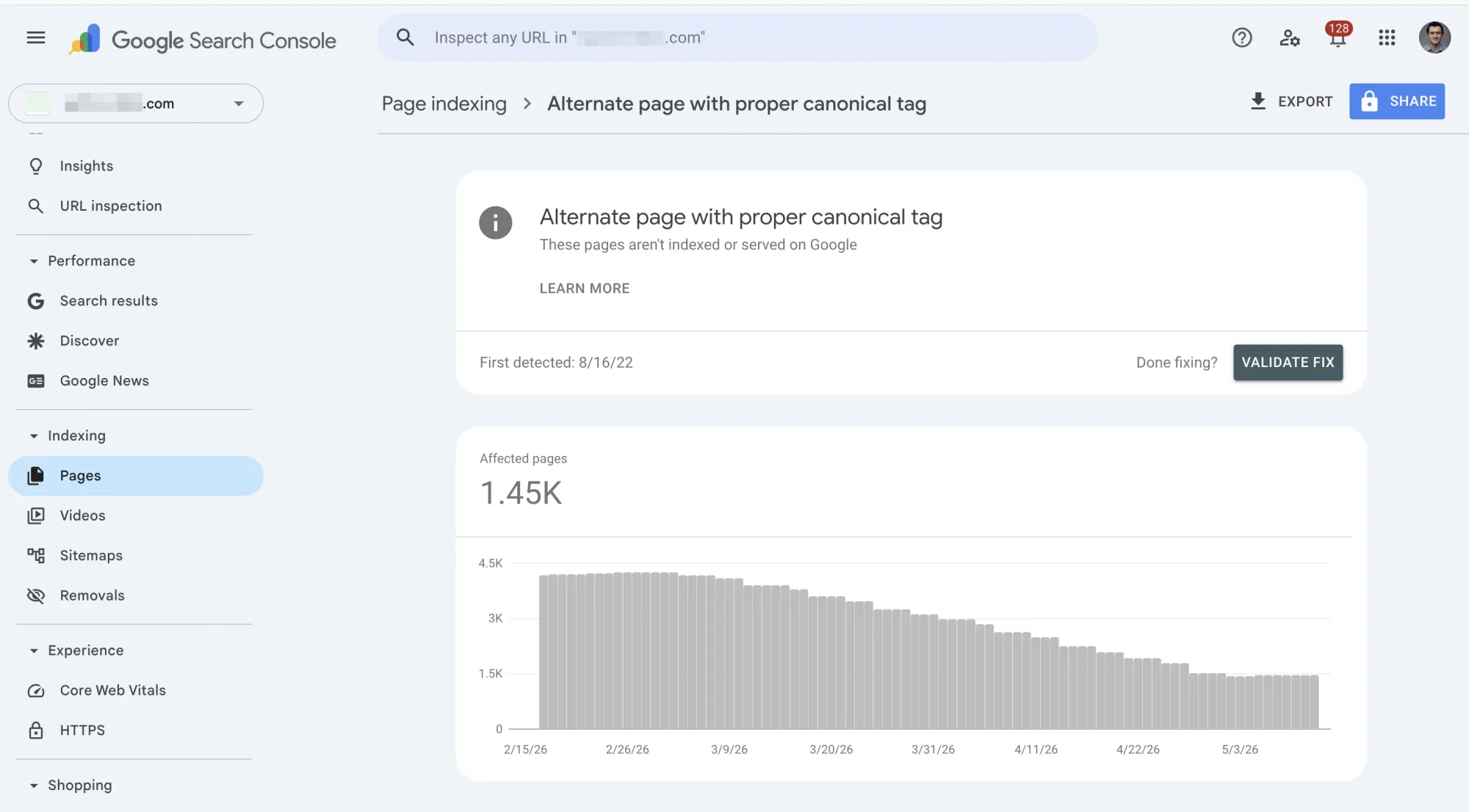
In your spreadsheet, add columns:
- URL
- Template/type (product, category, blog, parameter, pagination, etc.)
- Parameter pattern (utm, sort, filter, session, etc.)
- Canonical target (from HTML or URL Inspection)
- Google-selected canonical (from URL Inspection)
- Index intent (YES/NO)
- Notes / hypothesis
Pivot recipe (copy/paste):
- Rows: Template/type
- Columns: Parameter pattern
- Values: Count of URLs
This immediately shows whether you have a normal amount of alternates (e.g., product variants) or a runaway generator (e.g., faceted nav + tracking params).
### Step 2: Sample by pattern (don’t inspect random URLs)
For each top pattern in your pivot, inspect 3–5 URLs:
- One “clean” URL (no params)
- One “typical” alternate
- One “worst-looking” alternate (long params, deep path, odd casing)
Record:
- User-declared canonical
- Google-selected canonical
- Whether the page is crawlable and indexable
Step 3: Check canonical signal alignment (the 5-signal audit)
For a given URL pair (alternate → canonical), verify these signals align:
- Canonical tag points to the intended canonical
- Internal links mostly point to the canonical (not the alternate)
- Sitemap includes the canonical (and ideally excludes alternates)
- Redirects (http→https, non-www→www, trailing slash) resolve cleanly to canonical
- Content parity: alternate is truly a duplicate/near-duplicate of canonical
If 2–3 of these signals disagree, Google often chooses a different canonical than you expect.
Step 4: Apply the smallest effective fix
Fix the cause, not the symptom:
- If the URL should not be indexed: reinforce canonicalization and reduce crawl waste.
- If the URL should be indexed: remove the signals that demote it (wrong canonical, internal links, parameter handling, etc.).
Root-cause decision table (symptom → cause → test → fix → validate)
Use this during audits.
| Pattern you see in GSC | Likely cause | How to confirm (fast test) | Smallest safe fix | How to validate success |
|---|---|---|---|---|
| URLs differ only by UTM/tracking params | Tracking parameters creating duplicates | Crawl a sample: same content, different params; internal links include UTMs | Strip UTMs from internal links; consider parameter handling rules where applicable | GSC: alternates stop growing; URL Inspection shows canonical to clean URL |
Sort/filter/facet params (e.g., ?color=red&size=m) |
Faceted navigation generating indexable variants | Pivot shows huge counts by facet params; many combinations | Define a facet policy (index a curated subset only); canonical to base category; block crawl of non-value facets if needed | GSC: fewer discovered facet URLs; canonical targets remain stable |
| Trailing slash / case / http vs https / www variants | Inconsistent URL normalization | URL Inspection shows different canonicals; server returns multiple 200s | Enforce one version with 301s; ensure canonical tag matches final URL | Crawl: only one 200 version; GSC canonical selection stabilizes |
| Pagination URLs marked alternate | Canonicalizing page 2+ to page 1 (often intentional, sometimes harmful) | Check rel=canonical on page 2+; check whether page 2 has unique products/content | If you need page 2 indexed: self-canonicalize paginated pages; ensure internal links support them | GSC: paginated URLs move to indexed (if intended) |
| Product variants (size/color) | Variant pages intentionally canonicalized to parent | Confirm business intent: do variants need to rank? | If variants shouldn’t rank: keep canonical to parent; ensure internal links point to parent | Stable canonical selection; no loss of parent indexing |
| Canonical points to a URL that redirects | Canonical target not final URL | Fetch canonical target; see 301/302 | Update canonical to final 200 URL; fix redirect chains | URL Inspection: user-declared canonical equals final URL |
| Canonical target is noindex/blocked | Conflicting directives | Inspect canonical target indexing status | Remove noindex/block from canonical target or change canonical target | GSC: canonical target becomes indexable; alternates resolve |
| Hreflang + canonical conflicts | International setup mismatch | Check hreflang cluster + canonicals across locales | Align: each locale self-canonicalizes; hreflang references correct URLs | GSC: correct locale pages indexed; fewer alternates |
Common mistake: Jumping straight to “add a canonical tag.”
Do this instead: Fix whichever signal is contradicting your canonical (internal links and sitemaps are frequent culprits).
Fix patterns (what to do for the most common causes)
Fix pattern 1: Clean up internal links (the fastest win)
When to use: GSC shows lots of alternates with params, and you find internal links pointing to those alternates.
What to do:
- Remove UTMs and unnecessary params from:
- navigation links
- footer links
- internal banners
- related products/modules
- Ensure canonical URLs are used consistently in:
- breadcrumbs
- pagination links
- XML sitemaps
In practice: internal links are one of the easiest signals to control, and they often explain why Google keeps discovering alternates.
Fix pattern 2: Normalize with redirects (only when it’s truly the same page)
When to use: multiple URL versions serve the same content and you want one definitive URL.
Do:
- 301 redirect non-preferred versions to preferred (http→https, www, trailing slash, uppercase)
- Update canonical tags to the final preferred URL
Avoid: redirecting parameterized URLs blindly if parameters change content (filters/sorts). That can break UX and analytics.
Fix pattern 3: Parameter/facet policy (stop infinite URL growth)
When to use: faceted navigation creates thousands/millions of combinations.
Your options (choose intentionally):
- Canonicalize non-target facets to a base category
- Allow indexing only for curated, search-demand facets (e.g., “red dresses”) and make them stable landing pages
- Reduce crawl paths by limiting internal links to low-value combinations
Common mistake: Using robots.txt as a “deindex” tool.
Do this instead: Use robots.txt to reduce crawling only if you’re confident those URLs should never be indexed, and understand it can limit Google’s ability to see canonical/noindex signals.
Fix pattern 4: Canonical tag correctness checklist (implementation)
Use this when you suspect the canonical tag itself is wrong.
Canonical tag must be:
- Present in the rendered HTML (or server HTML if not JS-rendered)
- Absolute URL (recommended)
- Pointing to a 200 OK page
- Pointing to the preferred protocol/host/path
- Not pointing to a URL that is blocked/noindexed
- Consistent across duplicates
### Fix pattern 5: International (hreflang) alignment
When to use: alternates appear across language/country versions.
Rule of thumb: each locale URL should typically self-canonicalize, and hreflang should connect equivalent pages across locales. Conflicts (canonicalizing all locales to one) can cause the others to be treated as alternates.
Scenario table: what to do next (and what not to touch)
| Scenario | What it usually means | Action | Don’t do this | Validation |
|---|---|---|---|---|
| Alternates are mostly UTM URLs | Normal tracking duplication | Remove UTMs from internal links; keep canonical to clean URL | 301 every UTM URL (can be messy) | GSC alternates trend down; clean URL remains indexed |
| Alternates are facet combos | Crawl waste risk | Create facet policy; reduce internal linking to combos | Blanket noindex everything (may remove valuable facets) | Fewer discovered URLs; stable indexing of target pages |
| Alternates include valuable category pages | Wrong canonicalization | Fix canonicals/internal links/sitemaps so those pages self-canonicalize | Force-index with random changes | URL Inspection shows Google-selected canonical = that page |
| Alternates are product variants you don’t want indexed | Expected | Leave as-is; ensure parent is canonical | Try to “fix” by removing variants | Parent page indexed; variants remain alternates |
| Google-selected canonical differs from user-declared | Conflicting signals | Align signals (links, sitemap, redirects, content) | Keep changing canonicals without fixing contradictions | Google-selected canonical matches intent consistently |
What success looks like (verification + monitoring)
Verification checklist (copy/paste)
Use this after changes ship:
- For sampled URLs, Google-selected canonical = intended canonical in URL Inspection
- Canonical targets return 200 and are indexable
- Internal links predominantly point to canonical URLs
- XML sitemap contains canonical URLs (and excludes obvious alternates)
- Crawl shows fewer duplicate URL patterns being discovered internally
- GSC Pages report: alternate count is stable or declining for the fixed pattern
Monitoring guidance (realistic expectations)
- GSC status counts can lag; focus on trend direction, not day-to-day noise.
- Validate with:
- URL Inspection on representative samples
- a fresh crawl after deployment
- (if available) server logs to confirm reduced crawling of junk variants
Heuristic (not a universal rule): if alternates are growing rapidly week-over-week and dominated by a single parameter/facet pattern, treat it as a crawl efficiency issue worth addressing.
Copy/paste templates (use these in audits and dev tickets)
Template 1 — Audit note (canonicalization finding)
Finding: GSC reports “Alternate page with proper canonical tag” for URLs matching pattern: ________________
Intent: These URLs should be indexed? (YES/NO) ____
Observed:
- Sample URL(s):
https://example.com/__________
- User-declared canonical:
________________ - Google-selected canonical:
________________ - Internal links point to: (canonical/alternate/mixed)
____ - Sitemap includes: (canonical/alternate/both)
____
Hypothesis (root cause): ________________
Recommended smallest fix: ________________
Risk/side effects: ________________
Validation plan: Re-check URL Inspection + crawl + GSC trend in __ weeks.
Template 2 — Dev ticket (canonical + internal linking alignment)
Title: Align canonical signals for __________ URL pattern to prevent unintended alternates
Problem: Google is treating URLs like https://example.com/__________ as alternates and selecting https://example.com/__________ as canonical. Some URLs in this pattern are intended to be indexed (YES/NO: ____).
Acceptance criteria:
- Canonical tag on affected templates outputs:
https://example.com/__________(final preferred URL) - Canonical target returns 200 OK and is indexable
- Internal links generated by
__________component point to canonical URLs (no UTMs / no unnecessary params) - XML sitemap includes canonical URLs only for this template
Notes:
- Do not redirect parameterized URLs that change content without confirming UX requirements.
- After release, SEO will validate via GSC URL Inspection on a sample set.
Faceted navigation policy worksheet (quick, practical)
If facets are involved, fill this out before you change anything.
Goal: decide which facets deserve indexable landing pages.
| Facet type | Example | Search demand / business value | Should be indexable? | Implementation |
|---|---|---|---|---|
| Color | /dresses?color=red |
____ | YES/NO | If YES: create stable landing URL; if NO: canonical to base |
| Size | /shoes?size=10 |
____ | YES/NO | Usually NO; canonical to base |
| Sort | ?sort=price-asc |
____ | NO | Keep out of index; avoid internal links |
| Price range | ?price=50-100 |
____ | Depends | Often NO unless curated |
| Brand | ?brand=nike |
____ | Depends | Often YES if category-like |
Common mistake: Letting the CMS generate indexable URLs for every combination.
Do this instead: Decide intentionally which combinations are “real pages” vs “UI states.”
FAQ
Is “Alternate page with proper canonical tag” bad for SEO?
Not inherently. It often indicates Google is correctly consolidating duplicates. It’s only “bad” when important pages are being treated as alternates or when URL variants create crawl waste.
Why does Google ignore my canonical tag sometimes?
Because Google uses multiple signals and may choose a different canonical if signals conflict (internal links, sitemaps, redirects, content differences).
Should I noindex alternate pages?
It depends. If alternates are true duplicates and you can’t prevent them, noindex can be appropriate—but be careful: mixing noindex with canonical can create confusing signals. Prefer fixing the source of duplication (links/params) first.
Should I block alternate URLs in robots.txt?
Only if you’re confident they should never be indexed and you’re using it to reduce crawling—not as a deindex mechanism. Blocking can prevent Google from seeing canonical/noindex on those URLs.
How long until GSC updates after fixes?
It varies. Use URL Inspection for spot checks and watch trends over time rather than expecting immediate report changes.
Next steps (if you’re stuck)
- Run the pivot and identify the top 1–2 URL patterns driving the report.
- For each pattern, decide index intent (YES/NO) and apply the matching fix pattern.
- Validate with the verification checklist and document outcomes using the templates.
If you want, share (1) a redacted sample of 10 URLs from the report and (2) what types of pages they are (product/category/blog/facet). I’ll tell you which pattern you’re in and the smallest safe fix to test next.